
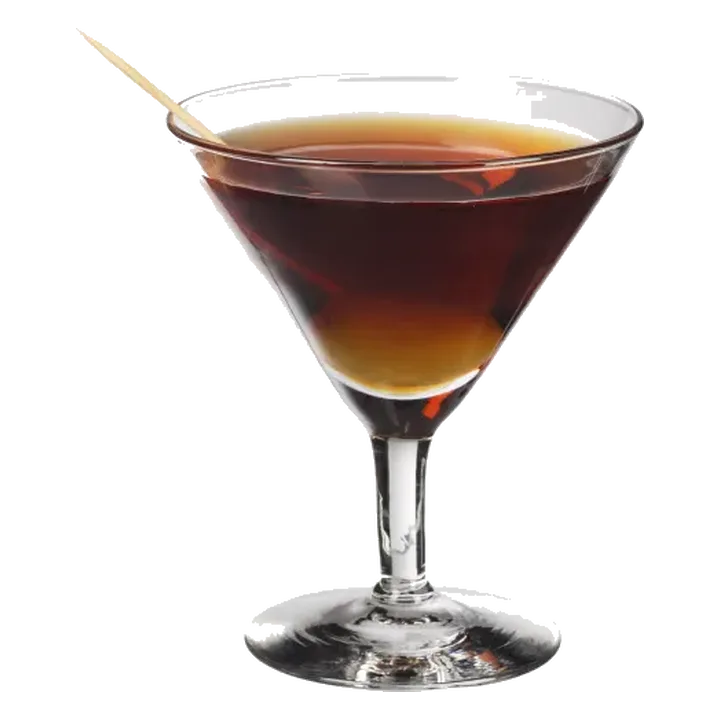
Adonis
4.2 63 ratings
Ingredients
How to make
Serve in a coupe glass
Prepare
- 1 Select and pre-chill a COUPE GLASS.
- 2 Prepare garnish of orange zest twist and skewered green olive.
Method
- 3 THROW (or STIR) all ingredients with ice.
- 4 STRAIN into chilled glass.
Garnish
- 5 EXPRESS orange zest twist over the cocktail and discard.
- 6 Garnish with skewered olive.
Flavour profile
14.2% alc./vol. · 0.9 standard drinks · 121 calories
History
While some characterize the Adonis as "The sweet version of the Bamboo," this description undersells the appeal of this exceptional vintage aperitif/digestif, which possesses an off-dry and aromatic quality. The Adonis was prepared for a photograph in a vintage Boadas Martini glass, as Boadas Bar's version is considered the finest encountered. Their generosity provided one of their last 20 original glasses and insight into their method: a "secret" dash of Italian red bitter liqueur enhances the flavor profile, unlike the orange bitters preferred by others. An attempt to find a Spanish vermouth or a highly expressive Torino sweet vermouth that would best suit the Adonis proved unsuccessful, as they were found to be too dominant or excessively sweet. Consequently, a more standard rosso vermouth was chosen. Experimentation with various sherry styles has led to a preference for a blend of palo cortado and amontillado.
The first known mention of the Adonis in print is in the "Pearls from Billy, the bartender" column in New York's The Sun newspaper on 27th March 1887. The column describes three customers, "three young bloods, with bell-crowned beavers of matchless sheen and silver-headed canes of ultra fashionable immensity who walk into the bar where Billy was bartending and order "Three Adonis cocktails, please." Billy proceeds the confidently make and serve them three cocktails which they drink, pay "fifteen cents each" for and leave. Then it becomes clear that Billy has no idea what an Adonis is. ""What on earth is an Adonis cocktail?" asked the reporter who had watched the incident. "Blessed if I know," said Billy, with an air of perfect frankness; "but I wouldn't be much of a bartender if I let any customer bluff me off with any new-fangled name. I gave them what I always have known as a turf club cocktail, and it suited. The first principle of good bartending is to know how to make everything on earth in the drink line, no matter whether you have ever heard of it before or not."" This irreverent column doesn't reveal what comprised an Adonis but it does tell us that it was a "new-fangled" cocktail at the time so dating its origin prior to 1897. It's another 16 years before the Adonis appears in a recipe book, Jacques Straub's 1913 Straub's Manual of Mixed Drinks establishing the recipe as two-thirds Italian (sweet) vermouth to one-third sherry with 2 dashes orange bitters. ADONIS 2 Dashes Orange Bitters. 1/3 Jigger Sherry. 2/3 Jigger Italian Vermouth. Stir. The origins of the Adonis name appear in Albert Stevens Crockett's 1931 Old Waldorf Bar Days where, along with the recipe, he reveals that the cocktail is named after a Broadway musical. The Adonis opened at Hooley's Opera House in Chicago in the summer of 1884 before moving to New York's Bijou Theatre in September of that year, where after 603 performances, it became the longest-running Broadway show of the era. Crocket mentions two stars of the show, Henry E. Dixey who played Adonis and Fanny Ward who played Cupid. Both joined the show for its New York run so dating the Adonis cocktail's creation between late 1884 and 1887, most likely 1885/6. ADONIS Named in honor of a theatrical offering which made at least two persons famous. One was Henry E. Dixey, a handsome and talented actor, long on Broadway; the other was Fanny Ward. Yes, Fanny Ward! One doesn't see as much of Fanny these days as one did when she played Cupid – speaking literally, that is, for Fanny in the play was Cupid. Fanny discovered England late in the last century, married a South African millionaire and had a bijou house in Berkeley Square. Her daughter married a peer. She herself is now teaching Paris, London and New York – and even Hollywood – that sixty years means nothing, if you know what to do. Two dashes Orange Bitters One-half Sherry One-half Italian Vermouth Stir Crocket stipulates equal proportions of sherry to Italian vermouth, quite different to Straub's vermouth heavy 1913 recipe but Crocket is in the minority with all other recipe books leaning towards Straub's two-thirds Italian (sweet) vermouth to one-third sherry. It is Harry Craddock, in his 1930 The Savoy Cocktail Book who upsets the established recipe by reversing the dominance of vermouth over sherry. Interestingly, Jacques Straub, and others, call this two-thirds dry sherry to one-third Italian vermouth recipe a "Harvard Cocktail". However, such is Cradock's influence that modern-day convention holds that this sherry-heavy recipe is an Adonis while a Harvard is a very different cognac-based cocktail. ADONIS COCKTAIL. 1 Dash Orange Bitters. 1/3 Italian Vermouth. 2/3 Dry Sherry. Stir well and strain into cocktail glass.