
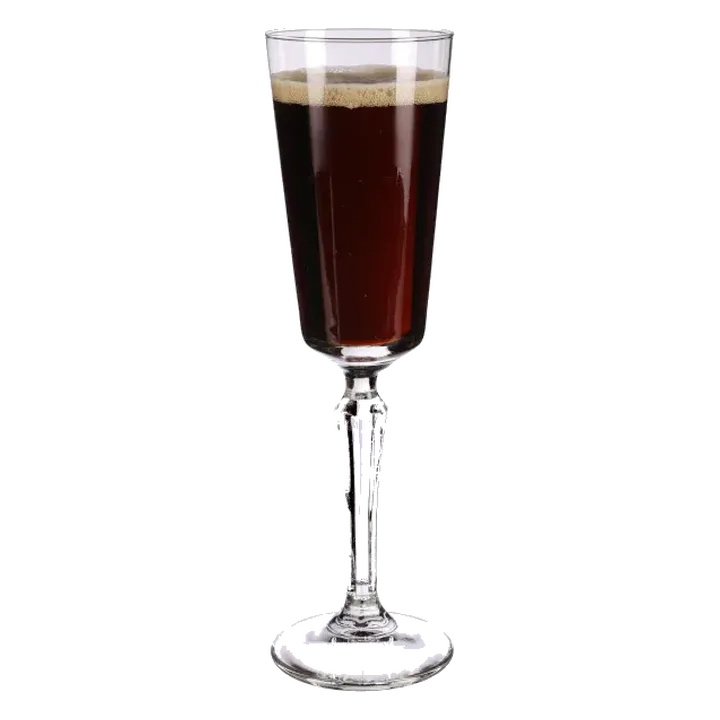
Black Velvet
3.8 25 ratings
Ingredients
How to make
Serve in a flute glass
Method
- 1 Select a FLUTE GLASS.
- 2 No garnish to prepare (unless drinking to celebrate St. Patrick's Day, in which case consider a shamrock or mint leaf).
- 3 Slowly POUR ingredients into chilled glass.
Flavour profile
7.7% alc./vol. · 0.7 standard drinks · 304 calories
History
Full-bodied stout and delicate dry sparkling wine combine unexpectedly, but this classic endures. A barspoon of sugar syrup may be desired.
This dark, somber cocktail is said to have originated at London's Brook's Club, or according to some, at the Shelbourne Hotel in Dublin, Ireland, in 1861. This was shortly after the death of HRH Prince Albert from typhoid fever on December 14th. The Queen, devastated, wore black for the remainder of her life, making the drink's combination of sparkling wine and black stout particularly fitting. However, its origins might trace back to a German cocktail from the 1830s known as "Menschenfreund," meaning philanthropist. Prince Albert was born in Bavaria, Germany, in 1819, which could be a connection. The cocktail first appeared in a published work in Harry Johnson's 1888 New And Improved Bartender's Manual, under the name "Champagne Velvet." This manual was written in both English and German. It was favored by Otto von Bismarck, the German Chancellor. This cocktail is also known as a "Bismarck," appearing under this name in Frank Newman's 104-page French-language book, Recettes des Boissons Anglaises et Americaines. The name "Black Velvet" only topped the recipe in Frank Meier's 1936 book, The Artistry of Mixing Drinks. Even then, German-born Meier listed it as a "BISMARCK or BLACK VELVET." His recipe specified "a split bottle of Guinness," with "split" referring to the small 187.5ml bottle size. CHAMPAGNE VELVET. (Use a large sized goblet. Forth this drink a bottle of Champagne and a bottle of Irish Porter must be opened. It is mixed as follows: Fill the glass ½ full with {Porter, the balance with Champagne; Stir up with a spoon slowly, and you have what is called Champagne Velvet, because it will make you feel within a short time as fine as silk. It is rather an expensive drink, but a good one. Bismark Glass No. 2 Take glass No. 2, fill it half stout, half champagne. Note. – This consumption, very pleasant to the taste, was a favourite of students in the Latin Quarter in 1896. BISMARCK or BLACK VELVET Into large tumbler with a piece of Ice, pour slowly a split bottle of Guinness's Stout add an equal amount of Champagne; stir gently and serve. In his 1948 book, Fine Art of Mixing Drinks, David A. Embury discussed this drink, stating, "I was first introduced to Black Velvet at the home of a very dear friend of mine in Montreal and I received one of the greatest of all the drinking surprises of my whole life. The combination of champagne and stout sounds terrifying - something like molasses and horseradish. Actually, it's excellent. The champagne cuts the heavy, syrupy consistency of the stout, and the stout takes the sharp, tart edge off the champagne. Each is the perfect complement of the other. Be sure, however, that you use (a) a good bottle of stout, (b) an extra-dry champagne - preferably a brut or nature."
Also known as Bismarck; Black Velvet; Imperial Shandy; Champagne Velvet