
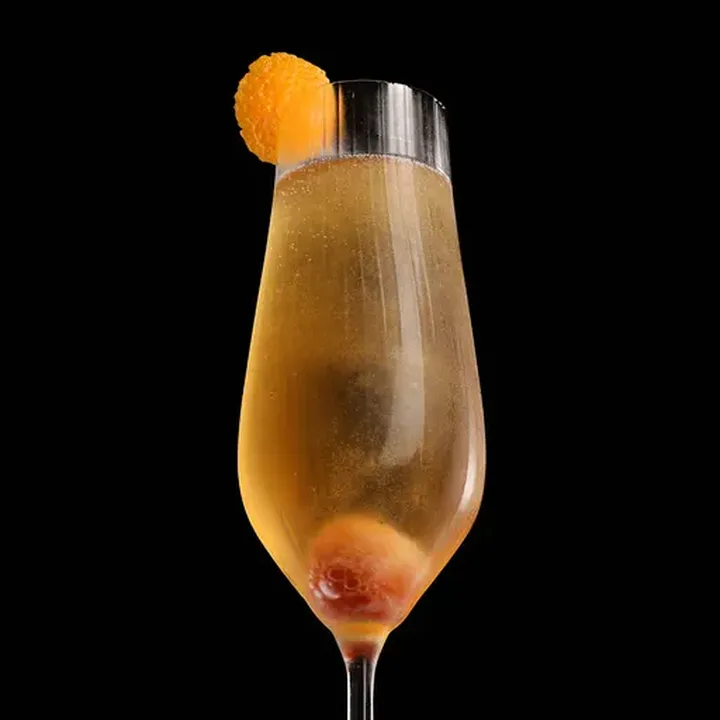
Champagne
4.0 98 ratings
Ingredients
How to make
Serve in a flute glass
Prepare
- 1 Select a FLUTE GLASS.
- 2 Prepare garnish of orange zest twist.
Method
- 3 COAT sugar cube with bitters and drop into chilled glass.
- 4 POUR chilled cognac over soaked cube.
- 5 TOP with sparkling wine.
Garnish
- 6 EXPRESS orange zest twist over the cocktail and discard.
Flavour profile
History
This drink begins bone dry, gradually becoming sweeter as the sugar cube dissolves at the bottom, its sweetness level dependent on how quickly it is consumed. In the 1940s, David Embury, an American attorney and amateur bartender, provided concise instructions for creating a Classic Champagne Cocktail in his book, The Fine Art of Mixing Drinks. He wrote: "This drink should be served in a pre-chilled saucer champagne glass. Place a medium-sized loaf of sugar in the glass and saturate it with Angostura bitters - about 2 dashes. Fill with thoroughly chilled champagne. Add a twist of lemon or orange peel, or both.." Embury also shared his assessment of the drink, stating, "From every point of view, other than cost, this cocktail is a decidedly inferior drink, and no true champagne lover would ever commit the sacrilege of polluting a real vintage champagne by dunking even plain sugar - much less bitters - in it. So if you must... serve this incongruous mess just for the sake of 'putting on the dog,' then, in the name of all that a true lover of the grape holds sacred, use a cheap domestic champagne or even an artificially carbonated white wine." Advice on preparation Despite Embury's reservations, this "incongruous mess" remains one of the most popular champagne cocktails and an enduring classic nearly 70 years later. This suggests it cannot be entirely without merit. As with most cocktails, the quality of the ingredients and their preparation are paramount. Here are eight tips for crafting a perfect Champagne Cocktail: 1. Utilize a thoroughly chilled, clean glass, pre-chilled in a freezer. While a flute offers a superior drinking experience, a saucer presents a more decadent appearance. 2. As cocktail historian David Wondrich notes, "Don't use loose sugar or try to crush the cube - the whole point isn't so much to sweeten the drink as to create bubbles, which the cube will do as it slowly dissolves." A rustic brown sugar cube is preferred for its appearance. 3. Place a small napkin (bevnap) over the glass, with the sugar cube resting on top. Dash the bitters over the cube until its surface is thoroughly soaked. The napkin effectively absorbs excess bitters and, with skillful handling, acts as a precise chute for guiding the saturated cube into the glass. 4. Employ high-quality cognac/brandy, stored in a refrigerator or even a freezer before use. Consider decanting a portion into a small bottle for such occasions. Pour a measure of the chilled cognac over the sugar cube in the glass. Cognac at room temperature will act as a detrimental heat source for this cocktail. 5. "Some prefer an ice cube in theirs, which will (to state the bleeding obvious) prolong the chill at the cost of a certain dilution," as Wondrich also states. Ice is superfluous if the sparkling wine, brandy, and glass are adequately chilled. 6. The dry, biscuity, and citrus notes of a good brut champagne or sparkling wine are essential to this cocktail. Angle the glass slightly and pour the chilled wine down the inside rim before straightening the glass to minimize foam. The sugar cube will continuously generate bubbles, so a careful pour helps retain carbonation, enhancing the drinking experience. 7. Embury advises, "Add a twist of lemon or orange peel, or both." Discard the twist(s) after expressing their oils. 8. Share and enjoy with friends. This cocktail is best suited for social gatherings rather than solo enjoyment. Depending on glass size, expect approximately 6 to 8 servings per bottle of sparkling wine, or up to 10 if serving conservatively.
One of the oldest cocktails, dating back to at least the mid-1800s. The Champagne Cocktail consists of a sugar cube doused in aromatic bitters, dropped into the base of a flute, over which a small measure of brandy is poured before the glass is topped up with champagne - hence the name. Although now often made with other brut sparkling wines, it remains one of the most popular 'champagne' cocktails. The origins of the Champagne Cocktail are lost in the mists of bartending history, with Wondrich saying it "dates from the Iron Age of American mixology - that final prehistoric period between the invention of the cocktail, whenever that was, and 1862 when the first cocktail book was published." The first written mention of the Champagne Cocktail appears in the 'Panama in 1855. An Account of the Panama Rail-road, of the cities of Panama and Aspinwall with sketches of life and characters on the Isthmus by Robert Tomes'. Published 1855 in New York by Harper & Brothers. On page 61, Tomes writes, "I profess the belief that drinking Champagne cock-tails[sic] before breakfast, and smoking forty cigars daily, to be an immoderate enjoyment of the good things of this world." On the following page, he handily goes on to describe in some detail how a Champagne Cocktail is made: What shall I drink?" I asked a friend at my side. "A Champagne cock-tail - the most delicious thing in the world - let me make you one", was his response; and he suited the action to the word. A bottle of prime, sparkling 'Mumm' was brought, a refreshing plateful of crystal ice, fresh from Rockland by the last steamer, and rather a medical looking bottle, upon which was written a direct, brief terms, 'Bitters'. My friend, whose benevolent eyes expressed pity for my sufferings, while his lips were eloquent of prospective alleviation to my-self, and of consciousness, the result of long experience, of his own anticipated enjoyment, pounded the crystal ice, with a series of quick, successive blows, pattered it into the tumblers like a shower of hail, dropping in the bitters, which diffused a glow like that of early sunrise, dashed in the sugar, which somewhat clouded the beautiful prospect, and gave what the artists call a dead tint to the mixture; then out popped the eager 'Mum', and the Champagne cock-tail, thus was perfected, went whirling, roaring, foaming, and flowing down mine and the friendly concocter's thirsty throats. The above account is interesting as it not only proves that Champagne Cocktails were made before 1855 but also shows that the drink was served in a tumbler over crushed ice and made with aromatic bitters, sugar syrup and champagne. Interestingly there is no mention of brandy - cognac or otherwise. In the world's first cocktail book, How to Mix Drinks, or The Bon Vivant's Companion, published in 1862, Jerry Thomas also omits the brandy commonly used in today's recipes. He also serves in a tumbler over broken (crushed) ice. I don't take the instruction to "Shake well" literally and presume he meant to stir. By the time Thomas wrote the 1887 edition of his book, fashion and the Champagne Cocktail had moved on. He calls for a goblet rather than a tumbler, the "broken ice" has been replaced with a "small lump of ice," and the use of sugar is introduced - much closer to the modern-day Champagne Cocktail. The other illustrious vintage cocktail books below also omit brandy: A LA 'BOB' LARIUS, CAPE NOME, ALASKA. Saturate a cube of sugar with five or six drops of Angostura bitters, place the sugar in a champagne glass with sugar tongs, fill the glass with cold champagne, and serve. Never stir or decorate this beverage. 1 lump Sugar in tall, thin glass. 1 small piece Ice. 2 dashes Angostura Bitters. 1 piece twisted Lemon Peel. Fill up with Champagne. Stir and serve. Put into a wine glass one lump of Sugar, and saturate it with Angostura Bitters. Having added to this 1 lump of Ice, fill the glass with Champagne, squeeze on top a piece of lemon peel, and serve with a slice of orange. One lump Sugar Two dashes Angostura Bitters One piece Lemon Peel, twisted Fill glass with chilled Champagne Put into a wine glass 1 lump of Sugar, and saturate it with Angostura Bitters. Having added to this 1 lump of Ice and ½ slice of orange, fill the glass with Champagne, squeeze on top a piece of Lemon Peel. A dash of brandy as required.