
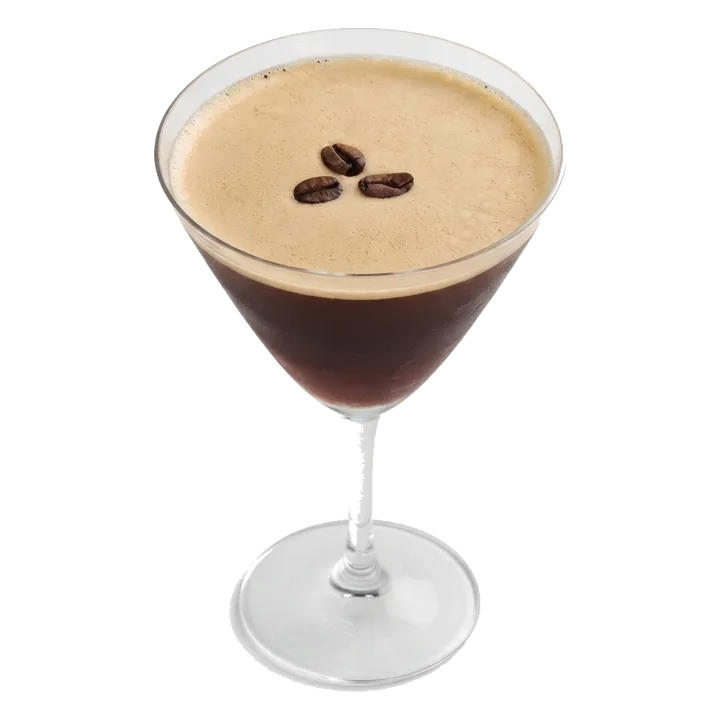
Espresso Martini
4.7 685 ratings
Ingredients
How to make
Serve in a martini glass
Prepare
- 1 Select and pre-chill a MARTINI GLASS.
- 2 Prepare garnish of lemon zest twist and coffee beans.
Method
- 3 SHAKE all ingredients with ice.
- 4 FINE STRAIN into chilled glass.
Garnish
- 5 EXPRESS lemon zest twist over the cocktail and discard.
- 6 Garnish with coffee beans arranged in a petal formation in the centre of the cocktail’s foamy head. The floating of three beans comes from the traditional serving of sambuca in Italy, where the floating beans are called con la mosca, meaning 'with the fly'. They represent health, wealth and happiness.
Flavour profile
18.6% alc./vol. · 1.4 standard drinks · 175 calories
History
The Espresso Martini, a contemporary classic of the 1990s, is often compared to a Vodka & Red Bull for those with more refined tastes. It's a caffeine-boosted drink made with ample vodka, espresso, and coffee liqueur. Quality ingredients are crucial for a good Espresso Martini. Use a good vodka and freshly brewed espresso, or an excellent UHT alternative. The espresso's crema, or creamy foam, is essential for the drink's appearance and success. Although it may seem counterintuitive to shake hot espresso with ice, allowing the coffee to cool will diminish the crema and spoil the cocktail. The amount of sugar needed to balance the drink depends on personal preference, but Dick Bradsell's original recipe included sugar syrup. While sugar syrup is omitted here, you might consider adding 2.5ml (half a bar spoon) to 5ml (1/6oz) of rich (2:1) sugar syrup, depending on your coffee liqueur. For added complexity, a brown, muscovado, or demerara syrup, or even honey, is recommended. If your coffee liqueur is particularly dry or bitter, added sweetness is more of a necessity than an option. This scaled-down recipe, suitable for small coupettes, incorporates sugar syrup: 40ml (1⅓oz) Vodka 25ml (5/6oz) Espresso coffee 15ml (½oz) Coffee liqueur 3.75ml (1/8oz) Sugar syrup 2 drop Saline solution In addition to the traditional garnish of three coffee beans, expressing a lemon zest over the drink's surface before discarding it adds a pleasant aroma without negatively impacting the foam.
The cocktail known today as the Espresso Martini was originally named Vodka Espresso and served on the rocks. It was created around 1983 by Dick Bradsell, a renowned bartender at the Soho Brasserie on Old Compton Street, London. The drink was made for a customer, described as a "top model" or an American model, who requested "Something that's gonna wake me up, then fuck me up." When asked about his inspiration for the drink, Dick Bradsell stated, "The coffee machine at the Soho Brasserie was right next to the station where I served drinks. It was a nightmare, as coffee grounds were everywhere, so coffee was very much on my mind. And it was all about vodka back then - it was all people were drinking." Over the years, there has been much speculation about the identity of the "model" whose request led to the creation of the Vodka Espresso. Some have suggested Kate Moss or Naomi Campbell, but Moss was only nine years old at the time, and Campbell was 13 and not American. Dick Bradsell adhered to traditional bartending principles, believing that patrons should be able to visit a bar, enjoy themselves, consume a reasonable amount of alcohol, and ideally, leave a good tip. He also maintained the privacy of his clientele. While the identity of the model remains unconfirmed, it is probable that she was not a "supermodel." However, local rumors suggest Marie Helvin as a more plausible candidate. As the 1980s transitioned into the 1990s, vodka remained a popular choice. This decade saw the rise of the "Neo Martini," a term applied to any vodka-based cocktail served in a V-shaped glass. These Neo-Martinis became highly sought after by bar patrons. In 1997, while working at Match bar on London's Clerkenwell Road, Dick Bradsell observed a fellow bartender named Vasco, whom he referred to as the "Portuguese sea captain," serving his Vodka Espresso straight-up in a Martini glass. Bradsell noted, "it needed adjustment. I used the ratio behind the Brandy Alexander as a template (espresso to vodka with 3 flavours in between)." Espresso Martini/Pharmaceutical Stimulant Into empty shaker glass 50mls good vodka 5mls cane sugar syrup 5mls Tia Maria 10mls Kahlua 25mls double strength espresso (and the better the coffee, the better the drink!) Add ice, shake, strain into prechilled glass. 3 coffee beans as garnish And if you can see through it or it is brown, not black, it's wrong. To finalize his collection of coffee-based cocktails, in 1998, Dick Bradsell renamed his drink Pharmaceutical Stimulant. This change was made to align with a list of cocktail names provided by Damien Hirst for the menu at his new Pharmacy restaurant in Notting Hill. The restaurant, which featured Damien Hirst's artwork, had Dick Bradsell as its bar manager. The location on Notting Hill Gate is now a Waitrose store.
Created by Dick Bradsell