
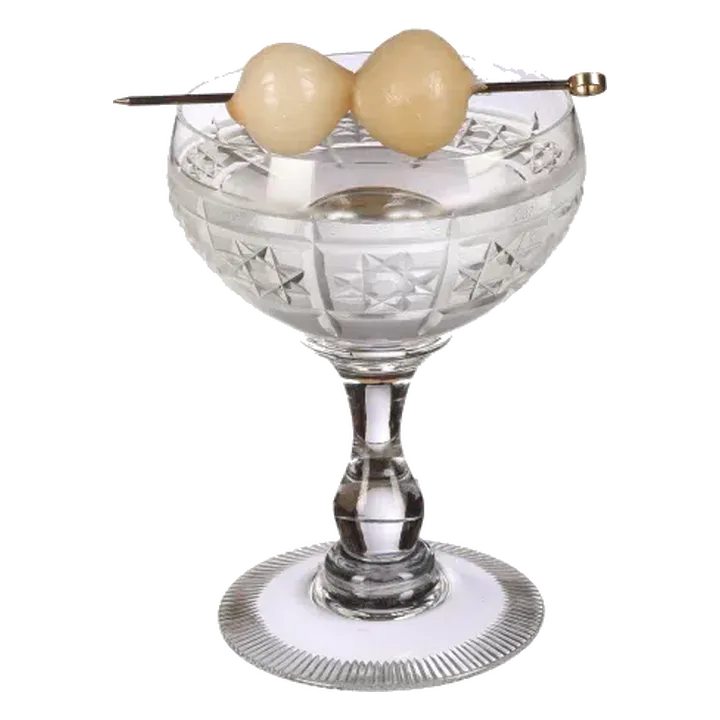
Gibson Dry Martini
4.2 74 ratings
Ingredients
How to make
Serve in a coupe glass
Prepare
- 1 Select and pre-chill a COUPE GLASS.
- 2 Prepare garnish of 2 skewered pickled cocktail onions.
Method
- 3 STIR all ingredients with ice.
- 4 FINE STRAIN into chilled glass.
Garnish
- 5 Garnish with skewered onions.
Flavour profile
29.4% alc./vol. · 1.6 standard drinks · 152 calories
History
A classic Dry Martini without bitters, using cocktail onions instead of olives or twists. Proportions are debated, but a 5:1 Dry stirred Martini ratio is favoured.
According to David Embury in his 1948 book, The Fine Art of Mixing Drinks, "The distinction between the Martini and the Gibson is simple. The Martini is served with an olive, the Gibson with a small pickled cocktail onion." However, the original difference between a Gibson Martini and other drinks was not its garnish, but rather the omission of orange bitters, which were common in Martinis at the time. The onion garnish did not appear for decades. The earliest mention of a Gibson is found in a piece by Edward W. Townsend. Published on Sunday, February 13th, 1898, in New York's The World newspaper, it was titled "Major Max Philosophizes. A Recent Society Function Discussed by the Major and His Wife." The relevant part reads: "Colonial Holland is a very superior article of gin, my dear, which if mixed with an equal part of dry vermouth and properly chilled, makes a Gibson cocktail. How you observe I put this spoonful of maraschino in the pit I have quarried in this grape fruit, and" – "But the Gibson cocktail is not crowned, is it?" Interrupted Mrs. Max. "As yet it has not been, but I have determined to devote the rest of my life to that pleasurable task, "replied the Major. "I purpose writing about its merits until it shall be crowned with the appreciation of mankind." Edward Townsend was a former vice president of San Francisco's Bohemian Club. It is at this club, in 1898, that the Gibson is said to have originated. The creators are thought to be either businessman and socialite Walter D. K. Gibson (1864 - 1938) or illustrator Charles Dana Gibson (1867 - 1944). Both men were members of the club. However, cocktail historians often attribute the creation of the minimalist Gibson Martini, with its lack of bitters, to Walter Gibson in the late 1890s. Charles Gibson is credited with inspiring the onion garnish for the already-existing Gibson Martini about ten years later (see below). The first complete recipe for a Gibson appears in William Boothby's 1908 book, The World's Drinks and How to Mix Them. GIBSON COCKTAIL. A LA MARTIN RAGGETT. Into a small mixing-glass place some cracked ice, half a jigger of French vermouth and half a jigger of dry English gin; stir thoroughly until cold, strain into a cocktail glass and serve. NOTE. – No bitters should ever be used making this drink, but an olive is sometimes added. The Gibson is also listed in Jacques Straub's 1913 Straub's Manual of Mixed Drinks and Tom Bullock's 1917 The Ideal Bartender. GIBSON COCKTAIL Use a large Mixing glass with Lump Ice. 1 jigger Gordon Gin. 1 pony French Vermouth. Stir; strain and serve in a Cocktail glass. None of these early Gibson recipes mention an onion garnish. However, Bullock's 1917 The Ideal Bartender does include a Martini-style cocktail called an "L. P. W." (made with old tom gin stirred with Italian and French vermouths) that specifies "Add a pickled onion and serve." Bullock also provides a recipe for an "Onion Cocktail" featuring old tom gin and Italian vermouth, crucially stating " no bitters used" and instructing to "Strain and serve with an onion." The absence of bitters and the presence of an onion garnish are the two defining characteristics of a Gibson Martini. Between the 1890s and 1930s, Charles Dana Gibson, mentioned earlier in relation to the Bohemian Club, created highly popular pen-and-ink drawings of voluptuous, corseted women, known as the Gibson Girls. [e.g. illustration above, titled Picturesque America, Anywhere Along the Coast] In 1908, the artist was patronizing New York's The Players Club, where a bartender named Charley Connolly is credited with adding an onion as a garnish to Charles' signature Martini.