
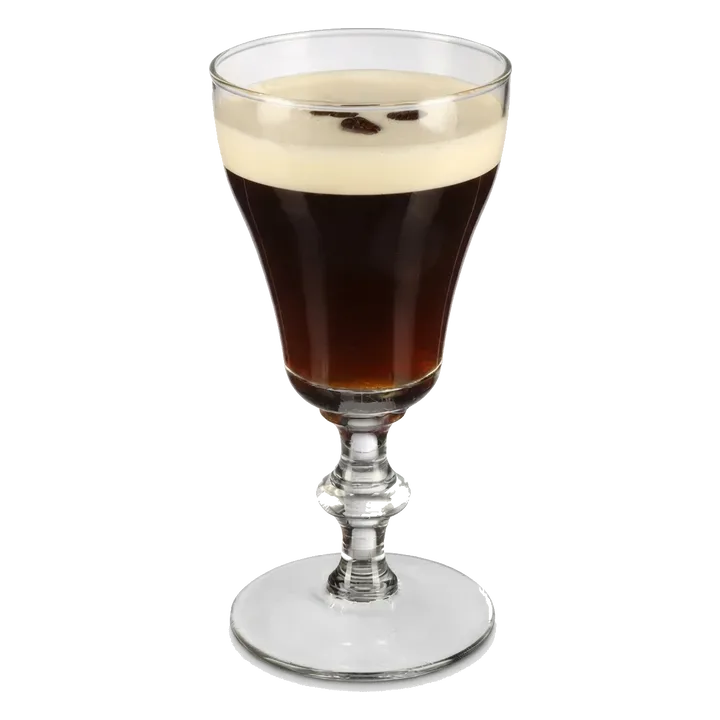
Irish Coffee
4.7 135 ratings
Ingredients
How to make
Serve in a toddy glass
Prepare
- 1 Select and pre-heat a TODDY GLASS.
- 2 Prepare garnish of grated nutmeg and/or float 3 coffee beans.
Method
- 3 Select a heat-proof glass and PRE-WARM by filling with very hot water and leave to stand.
- 4 Separately warm cream and WHIP or shake (ideally, use a milk frother to heat and whip cream).
- 5 Empty hot water from pre-warmed glass.
- 6 POUR whiskey, sugar syrup and hot coffee into pre-warmed glass.
- 7 Briefly STIR.
- 8 FLOAT heated and aerated cream (over the back of a warmed spoon).
Garnish
- 9 Dust with freshly grated nutmeg &/or float 3 coffee beans.
Flavour profile
6.8% alc./vol. · 0.7 standard drinks · 163 calories
History
Also known as Gaelic Coffee and correctly named 'Caife Gaelach' in Irish, this drink traditionally features hot filter coffee, Irish whiskey, and sugar (preferably brown) served in a heatproof stemmed glass called a toddy glass. It is finished with a layer of lightly whipped cream. The coffee, infused with whiskey and sweetened, should be crowned with a luxurious, mustache-eliciting inch-thick layer of cream for sipping. To ensure the cream floats atop the coffee instead of sinking, lightly whip, shake, or blend it before pouring it over the back of a spoon. Gently warming the cream and the spoon can also be beneficial. Sweetening the coffee with sugar enhances the drink's flavors and aids in keeping the cream afloat. Demerara or muscovado sugar syrup is preferred.
Hot coffee drinks topped with cream have a history stretching back to the mid-19th Century. Among the most famous are the Fiaker and Pharisäer, both served in Viennese coffee houses. By the start of the 20th-century, the Kaisermelange, Maria Theresia, and Biedermeier-Kaffee also appeared on menus in Vienna. In 19th-century France, combining coffee and spirits was common, with such drinks known as a Gloria. The Irish Coffee, originally named Sheridan's Gaelic Coffee, is a more recent creation. Joe Sheridan, a chef who later became a bartender, originally from Castlederg, County Tyrone, created it in late 1944 or early 1945. While working at Foynes' Port, Sheridan added whiskey to hot coffee to warm American passengers who were disembarking from a Pan Am flying boat on a cold, wet winter evening. The passengers are said to have inquired if they were drinking Brazilian coffee, to which Sheridan replied, "It's an Irish coffee". In the late 1930s, aircraft lacked the range for non-stop Atlantic crossings. From 1937, flying boats were utilized for the journey, with Foynes' Port on Ireland's west coast serving as the final refueling stop for Sikorsky S-42 and Boeing 314 planes. The first non-stop service to New York commenced on 22 June 1942, taking 25 hours and 40 minutes. These planes were relatively basic, and the flights were demanding, making the warming, spirited coffees a welcome refreshment for weary, cold travelers. The opening of Shannon Airport in 1942, situated on bogland on the northern bank of the Estuary, led to the closure of Foynes Port. Today, the Foynes Flying Boat Museum stands as a remnant of the former port. However, the tradition of serving Irish Coffees to transatlantic travelers persisted at the new airport. It was here, in 1947, that Stanton Delaplane, a travel writer for the San Francisco Chronicle, experienced his first Irish Coffee. Upon returning to San Francisco, Delaplane visited the Buena Vista Café, one of his preferred local establishments. Reportedly late on 10th November 1952, he recounted his travel tales to Jack Koepple, the bar's owner. Together, they attempted to recreate Sheridan's Gaelic Coffee. Despite numerous efforts, the drink's taste was not quite right, and the cream refused to float. This prompted Koepple to travel to Shannon Airport to observe the drink's preparation. After returning to San Francisco, Koepple continued his experiments. He also consulted with the city's mayor, who owned a dairy, regarding the challenges of making the cream float. Koepple discovered that cream, when two days old rather than fresh, whipped better and floated more reliably. Following further refinement, Koepple developed the method, recipe, and the 6oz heat-treated goblet that are still in use at the Buena Vista today. It is claimed that approximately 2,000 Irish Coffees are served daily at the establishment.
Also known as Gaelic Coffee & Caife Gaelach · Created by Joe Sheridan