
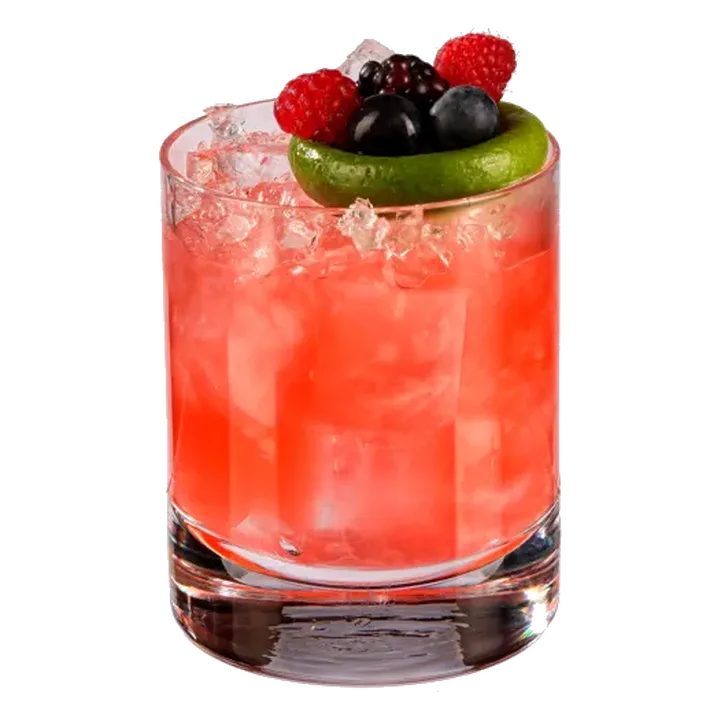
Knickerbocker
4.2 81 ratings
Ingredients
How to make
Serve in a old-fashioned glass
Prepare
- 1 Select and pre-chill an OLD-FASHIONED GLASS.
- 2 Prepare garnish of spent (squeezed) half lime shell and seasonal berries: raspberries, blackberries, blueberries.
Method
- 3 SHAKE all ingredients with ice.
- 4 STRAIN into glass 2/3rd filled with cubed ice.
- 5 TOP up glass with crushed ice.
Garnish
- 6 Garnish with lime shell and seasonal berries.
- 7 Serve with a straw.
Flavour profile
21.4% alc./vol. · 1.8 standard drinks · 231 calories
History
Fruity and refreshing – a party drink with predominant rum and raspberry flavours. Best made with homemade raspberry syrup.
The Knickerbocker cocktail emerged in the mid-19th century. Initial assumptions pointed to its creation at New York City's Knickerbocker Hotel, but this grand establishment, with its Beaux-Arts architecture, was not constructed until 1906, while the drink's first known printed appearance dates to 1862. What is a knickerbocker?: The term 'Knickerbockers' originally described the pant style adopted by Dutch settlers, rolled just below the knee. This is the origin of the word 'knickers.' In 1809, Washington Irving penned the satirical A History of New York under the pseudonym Diedrich Knickerbocker. The book, known as Knickerbocker's History of New York, led the word 'knickerbocker' to become synonymous with New Yorkers descended from the original Dutch settlers. The term also became associated with New York in general, appearing in references such as Jacob Ruppert's Knickerbocker Beer and the 1938 musical Knickerbocker Holiday. While the name implies a New York origin for the Knickerbocker Cocktail, its specific creator remains unknown. However, printed recipes reveal the drink's evolution over time. Cocktail's timeline: The Knickerbocker cocktail first surfaces in Jerry Thomas's 1862 publication, The Bartender's Guide. Knickerbocker. (Use small bar glass) ½ a lime, or lemon, squeeze out the juice, and put rind and juice in the glass. 2 teaspoonfuls of raspberry syrup 1 wine-glass Santa Cruz rum. ½ teaspoonful of Curaçoa. Cool with shaved ice; shake up well, and ornament with berries in season. If this is not sweet enough, put in a little more raspberry syrup. William Terrington's 1869 book, Cooling Cups and Dainty Drinks, presents two variations: the "Knickerbocker à la Monsieur," which closely matches Jerry Thomas's recipe, and the notably different "Knickerbocker à la Madame," calling for "½ pint lemon-water ice, ½ pint sherry or Madeira, 1 bottle seltzer water and ¼ pint shaven ice." In his 1882 New and Improved Bartender's Manual, Harry Johnson offers a single version, simply titled Knickerbocker, adding pineapple and orange to Jerry Thomas's original formula. KNICKERBOCKER. (Use a large bar glass.) 2 table-spoonful of raspberry syrup; 2 dashes of lemon juice; 1 slice of pineapple; 1 slice of orange; 1 wine glass full of St. Croix rum; One-half glass of Curaçao; The fill the glass with fine shaved ice; stir of shake well, and dress with fruit in season; serve with a straw. Theodore Proulx's 1888 Bartender's Manual features a recipe similar to earlier Knickerbockers but omits the essential raspberry syrup. Knickerbocker. In a cobbler glass, syrup and lemon juice as in a punch, one slice of orange and one of pineapple, one-half pony of curacao, one jigger of St. Croix rum, fill with ice and straws. Jerry Thomas, Terrington, Johnson, and Proulx all describe serving their Knickerbocker cocktails over shaved (crushed) ice in a tumbler or goblet. The variation served straight-up originates with Harry Craddock's 1930 The Savoy Cocktail Book, which includes two distinct recipes: The Knicker-Bocker Cocktail and The Knicker-Bocker Special Cocktail. The Knicker-Bocker is essentially a Gin Martini with sweet and dry vermouth, while the 'Special' version bears a resemblance to earlier Knickerbocker recipes. It is presumed that Craddock's second 'Special' version should also be shaken and served straight-up, as it appears in the 'cocktails' section of the book, where most entries instruct to "strain into cocktail glass." However, the absence of specific serving instructions raises the possibility that The Knicker-Bocker Special is included in this section solely due to its name, and Craddock may have omitted the instructions to avoid categorizing it incorrectly. Notably, the 1985 edition of The Savoy Cocktail Book removed the martini-style Knicker-Bocker and added the instruction "Shake well and strain into cocktail glass" to the Knicker-Bocker Special. KNICKERBOCKER COCKTAIL. 1 dash Italian Vermouth. ⅓ French Vermouth, ⅔ Dry Gin. Shake well and strain into cocktail glass. Squeeze lemon peel on top. KNICKERBOCKER SPECIAL COCKTAIL. 1 Teaspoon Raspberry Syrup. 1 Teaspoon Lemon Juice. 1 Teaspoon Orange Juice. 1 Chunk of Pineapple. ⅔ Rum. 2 Dashes of Curaçao.