
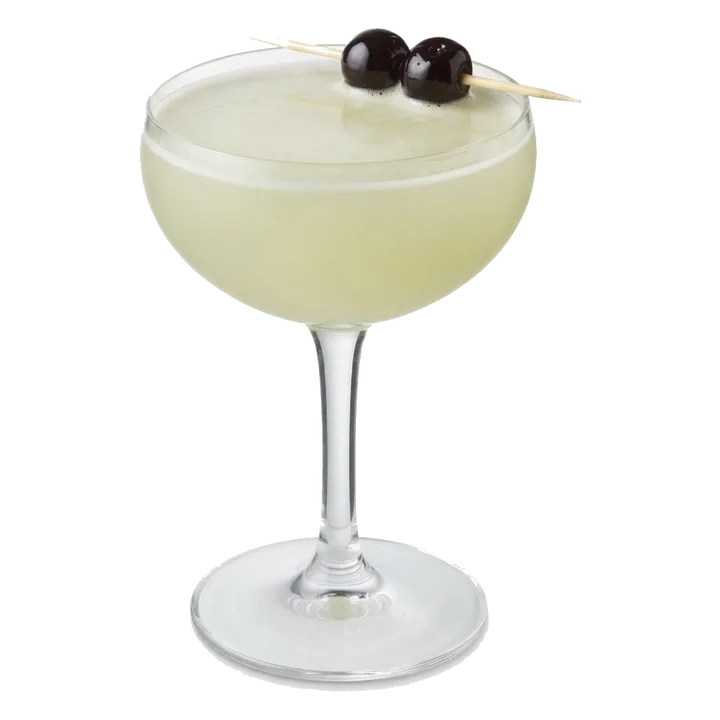
Last Word
4.7 1,324 ratings
Ingredients
How to make
Serve in a coupe glass
Prepare
- 1 Select and pre-chill a COUPE GLASS.
- 2 Prepare garnish of lime zest twist and skewered Luxardo Maraschino Cherries.
Method
- 3 SHAKE all ingredients with ice.
- 4 FINE STRAIN into chilled glass.
Garnish
- 5 Express lime zest twist over cocktail and discard.
- 6 Garnish with skewered maraschino cherries.
Flavour profile
22.4% alc./vol. · 1.7 standard drinks · 185 calories
History
Traditionally made with equal parts gin, Green Chartreuse, maraschino liqueur, and lime juice, but gin's proportion is often slightly increased (when using a 40%-43% alc./vol. gin). Chartreuse devotees will love this balanced, tangy cocktail.
The earliest known written reference to the Last Word appears in a list of cocktail names within a souvenir menu circulated to members of the Detroit Athletic Club in the July-August 1916 issue of the club's magazine. This menu only provides the cocktail's name and its price, which at 35 Cents, was double the cost of a Manhattan. Confirmation of the Last Word's connection to the Detroit Athletic Club is found in the notes accompanying the recipe in Ted Saucier's 1951 publication, Bottoms Up!. LAST WORD Courtesy Detroit Athletic Club, Detroit This cocktail was first introduced here around thirty years ago by Frank Fogarty, who was very well known in vaudeville. He was called the 'Dublin Minstrel,' and was a very fine monologue artist. 1/4 dry gin 1/4 maraschino 1/4 chartreuse 1/4 lime juice Ice Serve in cocktail glass. The Detroit Athletic Club, established in 1887 by young athletes, initially operated from a clubhouse on Detroit's Woodward Avenue. The club was revitalized in 1913 by prominent automotive and industrial leaders in Detroit, who commissioned the construction of a grand six-story Clubhouse on Madison Avenue. This venue, which opened in 1915, continues to be the club's present-day home. Ted Saucier's 1951 book states, "This cocktail was first introduced here around thirty years ago by Frank Fogarty." Calculating thirty years prior to the 1951 publication date places the timeframe around 1920, a discrepancy of only four years from the Last Word's appearance on the commemorative menu. When Saucier refers to "around here," he is indicating New York City, the location of his book's publication and where he served as publicist for New York's Waldorf-Astoria Hotel. Frank Fogarty, known as "The Dublin Minstrel," was a renowned American theatre entertainer born in County Tipperary, Ireland. He relocated to Warren Street, Brooklyn, New York City, at the age of two and resided there. His vaudeville career began in 1911 with a performance at the Orpheum in Brooklyn. He gained fame for his monologues, earning the New York Morning Telegraph contest for the most popular vaudeville performer in 1912. His act often commenced with a song and concluded with a recitation, leading some to suggest this duality inspired the drink's name. Fogarty, also active in politics, was elected president of the vaudeville actors' union in 1914. Evidence from the July 1916 menu confirms the Last Word was available at the DAC at least five months prior to Frank Fogarty's visit in December 1916. It is plausible, therefore, that Fogarty encountered and enjoyed a Last Word cocktail during his December 1916 visit to the club. His subsequent request for the recipe, presumably to recreate it at bars in New York, may explain his "introducing the Last Word around here" [New York] shortly before Prohibition. An alternative theory suggests that the DAC bartenders, aware of Fogarty's impending visit, created the Last Word in his honor, thereby accounting for its premium price and inclusion in the commemorative menu. The theory positing the Last Word's origin at the DAC is preferred over the alternative, which suggests Fogarty introduced the cocktail to the DAC during an earlier visit. The Last Word maintained its popularity post-Prohibition, leading to its inclusion in Ted Saucier's book. However, like many cocktails, it eventually faded from public consciousness until 2003. In that year, Murray Stenson, a bartender at Seattle's Zig Zag Café, rediscovered the recipe in a 1952 edition of Saucier's book. Stenson added the Last Word to the Zig Zag Café's menu, where it quickly gained favor with patrons. As Tan Vinh reported in The Seattle Times on March 11, 2009, "The drink became a cult hit around Seattle, then Portland and was eventually picked up at cocktail dens in New York City, where many bartending trends are set. The Last Word then started to appear on drink menus in Chicago and San Francisco and spread to several cities in Europe - especially around London and Amsterdam - and beyond." On the East Coast of America, Audrey Saunders opened Manhattan's Pegu Club in 2005. The Last Word was among the cocktails prominently featured by her team, including Phil Ward, credited with creating the Division Bell and the Final Ward, a notable variation of the Last Word. The Detroit Athletic Club became aware of the Last Word cocktail's resurgence when a Seattle newspaper inquired about the renowned drink's popularity in the city. The DAC subsequently reinstated the Last Word cocktail on its menu in 2009 and named a new rooftop lounge in its honor.
Created by Ted Saucier