
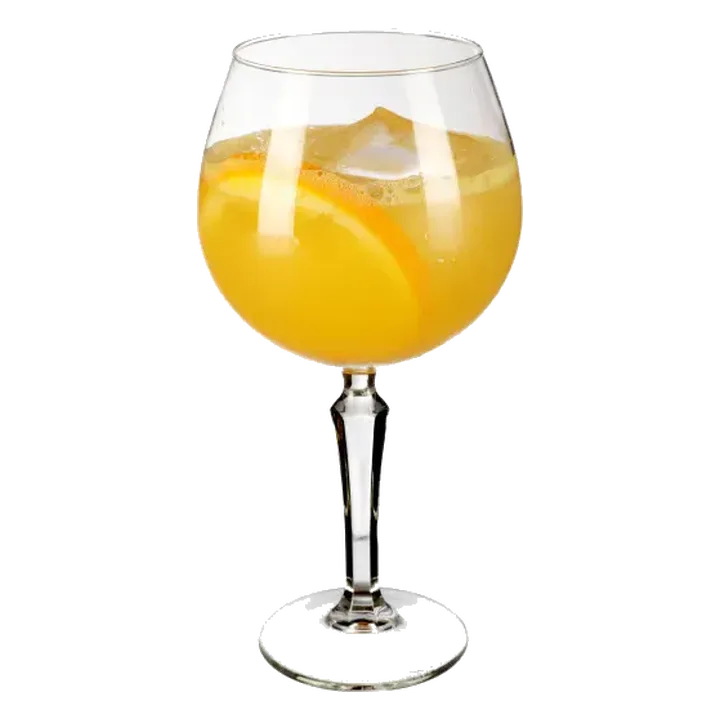
Mimosa
3.8 88 ratings
Ingredients
How to make
Serve in a goblet glass
Prepare
- 1 Select and pre-chill a GOBLET GLASS.
- 2 Prepare garnish of an orange zest twist and orange slice wheel.
Method
- 3 POUR first half of the sparkling wine and orange juice into ice-filled glass.
- 4 Briefly STIR.
- 5 TOP with the rest of the sparkling wine.
Garnish
- 6 EXPRESS orange zest twist over the cocktail and discard.
- 7 Garnish with orange slice wheel.
Flavour profile
4.7% alc./vol. · 0.6 standard drinks · 99 calories
History
David A. Embury writes in his 1948 book The Fine Art of Mixing Drinks, "Just another freak champagne mixture. It is not half bad and the ladies usually like it. Use a good quality domestic champagne, medium dry." When made with freshly squeezed orange juice and a quality dry/brut sparkling wine, this is a suitable breakfast cocktail. It is better served without ice, as a Buck's Fizz.
Named after the Mimosa tropical flowering shrub, Acacia dealbata - perhaps because of its trembling leaves, rather like the gentle fizz of this cocktail. The Mimosa is thought to have been created by Frank Meier at the Ritz Hotel in Paris, where he was head bartender from when the hotel's bar opened in 1921 until 1947. The cocktail made its print debut in Frank Meier's 1936 book, The Artistry of Mixing Drinks under the name "Mimosa or Champagne Orange" with the instruction, "In large wineglass, a piece of ice, the juice of one-half Orange; fill with Champagne stir and serve." The fact that Meier also calls the Mimosa a "Champagne Orange" is key to appreciating the earliest known reference to this cocktail being served at the Ritz. This was unearthed by cocktail historian Philip Greene, in his 2018 book A Drinkable Feast: A Cocktail Companion to 1920s Paris. Greene found two references to the drink within entries for 25 August and 29 August 1923 in poet and publisher Harry Crosby's diaries, which were reprinted in the 1977 book, Shadows of the Sun: The Diaries of Harry Crosby, edited by Edward B. Germain. Crosby's diary entry from 25 August 1923 Geraldine and champagne orangeades at the Ritz and afterwards to dance in the Bois and to dance in the Montmartre and finally at dawn to Les Halles where we were the only two dancers. Seven o'clock and the end of the last bottle of champagne and a crazy bargain with a sturdy peasant to haul us to the Ritz in his vegetable cart . . . upon the heaped-up carrots and cabbages while our poor man strained in the harness . . . Crosby's diary entry from 29 August 1923 I feel so lifeless, haven't even the courage to go out in the canoe, too weary to work at stocks and bonds or even to read the Bible. All I am good for is to drink champagne orangeades with Geraldine in the garden of the Ritz, the only oasis in the stagnant August Paris. This last entry makes more sense once you read Philip Greene's background notes. "Every morning, Caresse [Harry Crosby's wife], wearing a red bathing suit, would paddle Harry to work down the river Seine, to drop him off at the Place de la Concorde, so he could go to "work" at his billionaire uncle's (J.P. Morgan) bank, Morgan, Harjes & Co., as a stockbroker. That explains the references to "the canoe" and working "at stocks." If Frank Meier indeed created the Mimosa/Champagne Orange at the Ritz, then he did so sometime between the bar's opening in 1921 and the above August 1923 diary entries. Yet in his own The Artistry of Mixing Drinks book, published 13-15 years after this supposed creation date, Frank Meier makes no claim to its origin, despite a note at the front of the book [page 20] stating "Recipes marked FM were originated by the author" - the Mimosa has no such symbol (a stylised "FM" for Frank Meier in square box repeated around pages – see page 74 image above). Although the drink to the left of it, the "Koldkure" does. Perhaps the author or publisher omitted the crucial symbol or simply marked the wrong cocktail.
Created by Frank Meier