
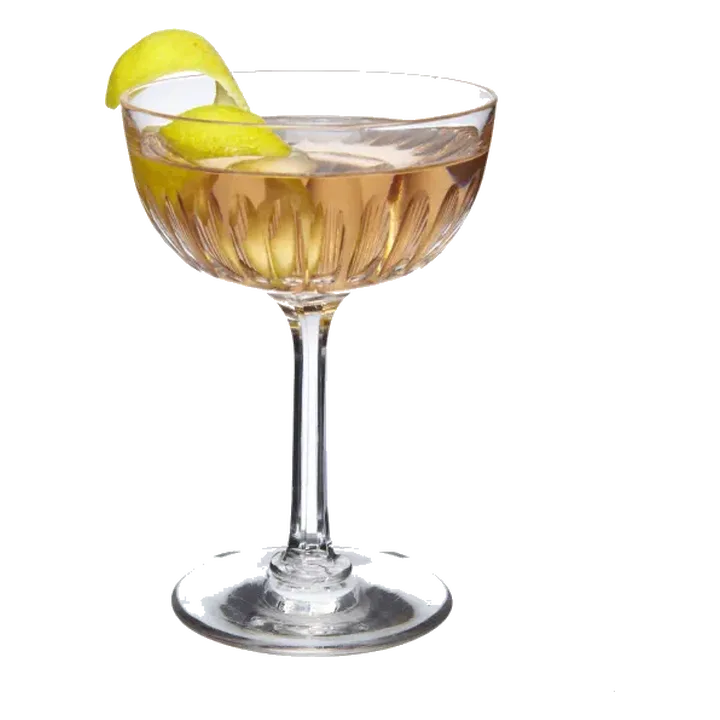
Pink Gin
4.0 54 ratings
Ingredients
How to make
Serve in a coupe glass
Prepare
- 1 Select and pre-chill a COUPE GLASS.
- 2 Prepare garnish of lemon zest twist.
Method
- 3 STIR all ingredients with ice.
- 4 FINE STRAIN into chilled glass.
Garnish
- 5 EXPRESS lemon zest twist over the cocktail and use as garnish.
Flavour profile
21.3% alc./vol. · 1.4 standard drinks · 134 calories
History
This cocktail benefits from dilution, hence the addition of water in this recipe. A spoonful of sugar also helps to mellow the Pink Gin. However, increasing the sugar content will necessitate less dilution. Achieving the perfect balance, which this recipe aims for, is subjective and depends on personal preference. Old Tom gin is used here for a more distinctive flavor, though London Dry gin is also a suitable option, particularly if you double the sugar to 5ml (one bar spoon).
The Pink Gin cocktail gets its name from the pinkish hue that aromatic bitters impart to gin. Initially, gin served at room temperature was poured into a glass that had been rinsed with a few dashes of bitters. The glass was swirled to coat the interior, and no ice was used, as it was not yet available. Its creation is attributed to the discovery of Angostura Bitters by Henry Workshop, an English ship's surgeon aboard H.M.S. Hercules. In 1826, while on patrol in the Caribbean searching for slave trader vessels, he encountered these bitters. They had been created two years prior, in 1824, by Johann Gottlieb Benjamin Siegert (1796-1870), a German doctor who had settled in Venezuela. Dr. Siegert served as the Surgeon-General of a military hospital in Angostura and originally developed the bitters to treat stomach ailments and indigestion among his fellow settlers, not for cocktail use. The town of Angostura, now known as Ciudad Bolivar (renamed in 1846 in honor of Simon Bolivar), is situated on the Orinoco River, which connects it to the Caribbean. Through this trade route, Siegert's bitters likely reached the Caribbean islands, where sailors, seeking remedies for upset stomachs and seasickness, would have been potential customers. The British Admiralty already mandated the use of chinchona bark (quinia) to prevent tropical diseases. As a medical professional, Workshop was intrigued by Angostura, having heard it contained chinchona and other herbal remedies. He acquired two bottles of the bitters during shore leave in George Town, a port in the Cayman Islands. Back on the ship, he and the captain, Jack Bristow, mixed a small quantity of the medicinal bitters with their gin ration. They found the resulting pink drink to be agreeable and shared it with other officers. Word of 'Pink Gin,' as it came to be known, spread, gaining popularity among Royal Navy officers. By the mid-19th century, the drink was widely served across England.