
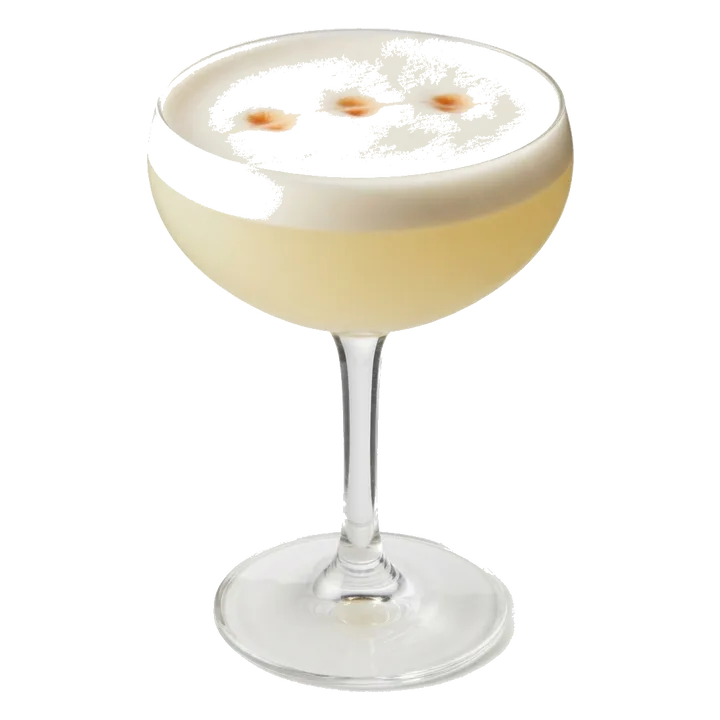
Pisco Sour
4.7 212 ratings
Ingredients
How to make
Serve in a coupe glass
Prepare
- 1 Select and pre-chill a COUPE GLASS.
- 2 Prepare garnish of Amargo Chuncho bitters or other aromatic bitters.
Method
- 3 SHAKE all ingredients with ice and strain back into shaker.
- 4 DRY SHAKE (without ice).
- 5 FINE STRAIN into chilled glass.
Garnish
- 6 Garnish and finish cocktail with three drops Amargo Chuncho bitters or Angostura aromatic bitters on the surface to signify health wealth and happiness.
Flavour profile
15.4% alc./vol. · 1.4 standard drinks · 155 calories
History
Bartenders in Peru generally prefer their Pisco Sours blended rather than shaken, and it is indeed a brilliant cocktail when prepared this way. However, a preference exists for shaken Pisco Sours. (Similarly, while Daiquiris in Cuba tend to be blended, a preference for shaken Daiquiris also exists.) Although some opt to omit the egg white, like most sour-style cocktails, the Pisco Sour is superior with it. A small, fresh egg white, yielding approximately 15ml (½oz) to 20ml (⅔oz), is sufficient. Some also suggest using powdered sugar instead of caster sugar syrup, which can enhance this sour cocktail (akin to the Daiquiri). In such cases, use 3 spoons (measured with a 5ml bowl) of powdered sugar in place of the syrup. The choice of pisco is a more significant point of discussion. Peruvian colleagues favor pisco made from the Quebranta grape or an acholado (a blend of grape varieties). However, a preference leans towards Peruvian pisco made from the more aromatic Italia grape, ideally a mosto verde Italia pisco. Alternatively, Chilean pisco offers good-value options. Convention dictates that the Pisco Sour is garnished with three drops of aromatic bitters, symmetrically placed on its foam. This not only enhances visual appeal but also helps mask the eggy aroma of the egg white. Angostura or similar aromatic bitters suffice, but for authenticity, consider Peruvian Amargo Chuncho bitters, derived from various Amazonian barks and herbs. Some also add a dusting of cinnamon to the cocktail's surface or the glass rim. A somewhat controversial addition, beyond the use of Italia pisco, is a dash of orange flower water. A preference also exists for serving these cocktails straight-up in a frozen, heavy-bottomed old-fashioned glass to maintain their icy temperature longer, although a frozen coupe also functions well (and is visually appealing for photographs). Finally, while lime juice was previously specified exclusively, a preference now exists for a split between lime and lemon juice, with lime being predominant. Nevertheless, using 22.5ml (¾oz) of lime juice results in a very tasty, more straightforward cocktail.
The documented origins of the Pisco Sour have shifted as earlier evidence has surfaced. In the mid-1980s, a Chilean newspaper, El Comercio de Iquique, reported that Elliot Stubb, an English steward from a sailing ship called Sunshine, created the Pisco Sour in 1872. Stubb allegedly opened a bar in Iquique, which was then a Peruvian port but is now in northern Chile. However, further examination suggests a quote attributed to Stubb actually referred to the Whiskey Sour, a precursor to the Pisco Sour whose origins predate this by even longer in the United States. In 2009, Luis Guillermo Toro-Lira Stahl and Michael P. Morris published a document titled Clarifying the legends in the history of pisco sour. This publication traced the Pisco Sour's origins to Victor Vaughen Morris Jones, known as Victor Morris, who was one of the authors' grandfather. Victor Morris, originally from Salt Lake City, Utah, relocated to Peru in 1903. His initial employment was as a cashier for the Cerro de Pasco Railroad railway company in Cerro de Pasco. Family accounts and legend suggest that Morris devised the Pisco Sour during the inauguration of the line from Oroyo, after exhausting his supply of whiskey for the Whiskey Sours he was preparing for an estimated 5,000 attendees. Morris subsequently moved to Lima. With the support of his long-time friend Daniel C. Babbitt, he inaugurated Morris' Bar at 847 Calle Boza on 1st April 1916. Morris, also known by the nickname Gringo, gained recognition for his Pisco Sours, and the establishment thrived. The bar's original visitor books, totaling 82 pages and titled Morris' Bar Register, remain with the Morris family. They document over 2,200 signatures, indicating a high-profile clientele that included numerous American visitors such as diplomats, businessmen, lawyers, and journalists. Among the notable names recorded are Emiliano Figueroa, a former president of Chile and ambassador to Peru; the millionaire Roger W. Straus; and Elmer Faucett, the founder of the Company of Faucett Aviation. Of particular interest is John Lannes from the Bank Exchange in San Francisco, which was celebrated for the Pisco Punch. Numerous comments within this register attest to the quality of Morris' Pisco Sours. This is further supported by a July 1924 advertisement for Morris' Bar in the South Pacific Mail. This newspaper, published weekly in English by Nelson Rounsevell from the Chilean port of Valparaiso, was owned by a friend of Morris who had also worked in Cerro de Pasco. The advertisement posed the question, "Have you registered at the Morris Bar LIMA?" It also noted the register's utility for contacting [English-speaking] acquaintances and concluded by stating the bar "has been known for many years for their 'Pisco Sours'." An earlier mention of the Pisco Sour appeared in the 22nd April 1921 edition of the Peruvian magazine Mundial. This publication described the drink as white and attributed its creation to "Mister Morris." The 1929 Lima directory, titled The City of the Viceroys, lists the Pisco Sour as one of the cocktails available at Morris Bar under the section "visitelo y pida alguna especialidad" (visit it and ask some speciality). Unfortunately for Victor, it appears that some bartenders formerly employed at Morris' Bar departed and brought his recipe to neighboring establishments. Bars such as the Hotel Bolivar, which opened in December 1924, and the Lima Country Club, which opened in February 1927, benefited from this. The competition for affluent foreign patrons evidently had a negative impact on his bar's success. Victor's financial situation and health deteriorated, leading to his declaration of voluntary bankruptcy and the closure of Morris Bar in 1929. He passed away a few months later, on 11th June, from cirrhosis at the age of 56. In December, Morris' wife, Maria Vargas, emigrated to San Francisco, California, with their three children. The bar at The Hotel Bolivar, with its substantial guest turnover and staff largely comprised of former Morris bartenders, is widely credited with popularizing the Pisco Sour. The drink's continued existence is also attributed to Mario Alfonso Bruijet Burgos, a bartender who worked at Morris' Bar from 1924 and subsequently served Pisco Sours at the Hotel Maury until his retirement. Some accounts suggest Bruijet was the one who introduced bitters to the recipe after relocating to the Maury. This narrative, with its various developments, was the widely accepted origin of the Pisco Sour until 22nd February 2012. On that date, Peruvian writer Raúl Rivera Escobar uploaded a scanned copy of a pamphlet published in Lima in 1903 by S.E. Ledesma. Titled Nuevo Manual de Cocina a la Criolla (New Manual of Creole Cooking), page 32 of this document includes a recipe labeled simply as 'Cocktail'. This recipe contains "egg white, a cup of pisco, a teaspoon of sugar and a few drops of lime juice to taste." This is clearly a Pisco Sour and represents the earliest known recipe for the drink. "An egg, a glass of pisco, a teaspoon of fine sugar and a squeeze of lime, will open up a good appetite. You can make up to three cups with an egg and a well-rounded teaspoon of fine sugar, adding otherwise much more per cup. Hit [shake] all this in a shaker or punch bowl, to form a little punch." Consequently, the Pisco Sour dates back to 1903 or earlier and appears to originate from Peru rather than Chile. It is likely that the identity of the first person to adapt a Whiskey Sour recipe using pisco as the base spirit will never be known. Similarly, the originator of adding bitters to the drink remains unknown. However, it is a remarkable coincidence that Victor Morris also emigrated to Peru in 1903. Joe Baum is credited with the Pisco Sour's recognition beyond its native Peru and Chile, having promoted it in the 1960s at La Fonda Del Sol in New York, USA. The Pisco Sour continues to gain popularity globally, with International Pisco Sour Day observed worldwide on the first Saturday of February each year.