
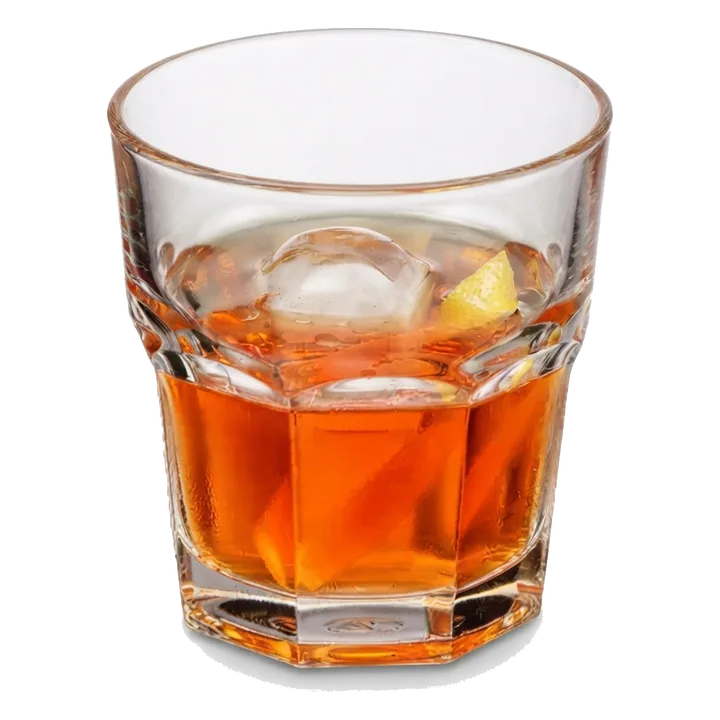
Sazerac (New Orleans style)
4.2 161 ratings
Ingredients
How to make
Serve in a rocks glass
Prepare
- 1 Select and pre-chill a ROCKS GLASS.
- 2 Prepare garnish of lemon zest twist.
Method
- 3 Fill glass with ice and set aside.
- 4 In another glass, STIR other ingredients with ice.
- 5 Empty ice from the glass you set aside and RINSE this now chilled glass with absinthe (or Herbsaint).
- 6 STRAIN the cocktail into the absinthe/Herbsaint-washed glass.
Garnish
- 7 EXPRESS lemon zest twist over the cocktail and use as garnish.
50.0% alc./vol. · 1.3 standard drinks · 131 calories
History
New Orleans Sazeracs use only rye whiskey and sugar, stirred and strained into an Herbsaint-washed glass.
The origin of the Sazerac cocktail is detailed in Stanley Clisby Arthur's 1937 book, Famous New Orleans Drinks & how to Mix 'em. For a long time, this account was accepted as fact. However, cocktail historian David Wondrich has suggested that the Sazerac may have begun as a bottled Whiskey Cocktail sold by the Sazerac company. As the saying goes, "never let the truth stand in the way of a good story." Before the Sazerac existed, brandy-based cocktails were served in New Orleans. These early mixed drinks likely contained bitters, possibly Stoughton's Bitters, a medicinal stomach bitters that is no longer produced. While the ingredients of the Sazerac have changed over time, its distinct flavor has always come from a key ingredient: Peychaud's aromatic bitters, created by Antoine Amedee Peychaud. Peychaud's story began in 1795 when he arrived in New Orleans as a refugee. His father had fled the island of San Domingo after a slave rebellion disrupted their family's coffee plantation. Antoine became a pharmacist and in 1834, he purchased his own drug and apothecary store at 437 Rue Royale (then No. 123 Royal Street). It was here that he developed an 'American Aromatic Bitter Cordial,' which he marketed as a medicinal tonic. Such tonics were popular at the time, and many similar products were available. Antoine also mixed his bitters with brandy and other spirits. It has been incorrectly claimed that Antoine invented the word 'cocktail' and the term 'coquetier' for the measure he used. However, the word "cocktail" first appeared in print in 1806, in a newspaper in upstate New York, when Antoine was still a child. Meanwhile, around 1850, Sewell T. Taylor, a New Orleans entrepreneur, left his career as a bar owner to enter the liquor business. He became the local agent for 'Sazerac-du-Forge et Fils,' a French cognac company from Limoges. His establishment, the Merchant's Exchange Coffee House at 13 Exchange Alley, was subsequently taken over by either Aaron Bird or John B. Schiller. Exchange Alley was formerly located between Royal Street and Exchange Place in the French Quarter, where the Wyndham Hotel now stands. A service road beneath the hotel still connects these two streets. It was at the Exchange Coffee House, sometime between 1850 and 1859, that the Sazerac Cocktail was created. It was named after Taylor's Sazerac cognac and made with Peychaud's aromatic bitters and sugar. The cocktail quickly became the bar's signature drink. In 1869/70, Thomas H. Handy, who had been the bar's bookkeeper, acquired the Exchange Coffee House and renamed it the Sazerac Coffee House in honor of its signature cocktail. Around this time, Antoine Peychaud faced financial difficulties and sold his pharmacy, including the formula and brand name for his bitters, which Handy purchased in 1873. Having acquired both the bar and the necessary bitters, Handy encountered a challenge: cognac, the primary ingredient of the Sazerac Cocktail, became difficult to obtain. The phylloxera aphid, which targets vine roots, devastated French vineyards in the late 1860s and 1870s, leading to a significant halt in cognac production. This forced Handy to alter the Sazerac Cocktail's recipe. He continued to use the essential Peychaud's bitters but replaced the cognac with American-distilled Maryland Club rye whiskey, while still including a dash of cognac. Around this period, perhaps before the switch to rye whiskey, a splash of absinthe, which was becoming fashionable, was added to the Sazerac. As cognac grew scarcer, it gradually disappeared from the drink. Stanley Clisby Arthur's 1937 book, Famous New Orleans Drinks & how to mix'em, states, "The absinthe innovation has been credited to Leon Lamothe who in 1858 was a bartender for Emile Seignouret, Charles Cavaroc & Co., a wine importing firm located in the old Seignouret mansion still standing at 520 Royal Street. More likely it was about 1870 when Lamothe was employed at Pina's restaurant in Burgundy Street that he experimented with absinthe and made the Sazerac what it is today." Before his death in 1889, Handy shared his house cocktail's recipe with William T. "Cocktail Bill" Boothby, who published it in his 1908 book, The World's Drinks and How to Mix Them. Sazerac (Boothby's recipe) ¾ jigger Whiskey 2 dashes Peychaud Absinthe to wet glass ½ spoon Sugar syrup 1 slice Lemon peel Chill cocktail glass, wet with few drops absinthe and toss out. Stir other ingredients well with ice, strain into prepared glass and serve with ice water chaser. In the 1890s, the Sazerac Company began bottling and marketing the Sazerac Cocktail, using rye whiskey instead of cognac. The cocktail, which remained a specialty at the Sazerac Bar, underwent further adaptation in 1912 when absinthe was banned in the US. The Sazerac company developed a product called Herbsaint as an absinthe substitute. Although absinthe has been legal in the USA since 2007, most bars in New Orleans continue to prepare their Sazerac Cocktails with Herbsaint rather than absinthe. The Sazerac Bar reopened after Prohibition at 300 Carondelet Street. In 1949, Seymour Weiss, who was the Vice President and Managing Director of the nearby Roosevelt Hotel, acquired the rights to use the Sazerac Bar name from the Sazerac Company. He renovated a former Wine and Spirits store on Baronne Street and inaugurated the new Sazerac Bar on September 26, 1949. Weiss announced that the new bar would lift its 'men only' policy and welcome women. This was a brilliant marketing strategy, and women flocked to the opening, leading to the event being known as 'Storming the Sazerac.' In 1959, the Sazerac Bar on Baronne Street closed, and its name was transferred to the hotel's Main Bar, which had opened in 1938. The Sazerac Bar continues to be popular in this location and is considered the spiritual and actual home of the Sazerac, serving approximately 40,000 Sazeracs annually. (For clarity, the hotel originally opened in 1893 as The Hotel Grunewald, later became The Fairmont, then The Roosevelt, and reopened as The Fairmont following Hurricane Katrina.) In 2007, Ann Tuennerman, then associated with The New Orleans Culinary and Cultural Preservation Society, urged the Louisiana legislature to "Save the Sazerac." The following March, state senator Edwin R. Murray introduced a Senate Bill to designate the Sazerac as Louisiana's official state cocktail. The bill was defeated on April 8, 2008, but following further discussion and lobbying, on June 23, 2008, the Louisiana Legislature passed a bill officially proclaiming the Sazerac as New Orleans' official cocktail.