
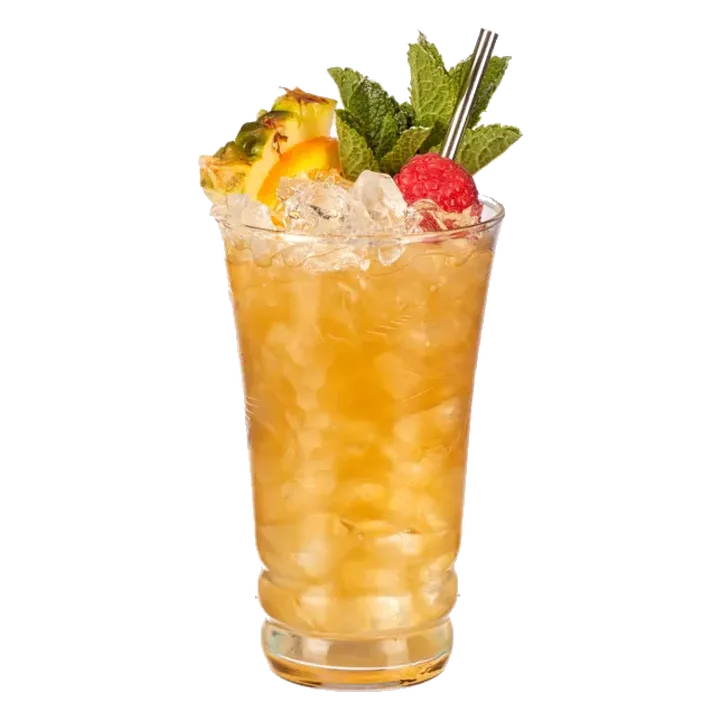
Sherry Cobbler
4.2 30 ratings
Ingredients
How to make
Serve in a collins glass
Prepare
- 1 Select and pre-chill a COLLINS GLASS.
- 2 Prepare garnish of pineapple wedge, orange slice, mint sprigs and seasonal berries.
Method
- 3 SHAKE all ingredients with ice.
- 4 FINE STRAIN into glass filled with crushed ice.
Garnish
- 5 Garnish with pineapple wedge, orange slice, mint sprigs bouquet and seasonal berries.
Flavour profile
11.9% alc./vol. · 0.9 standard drinks · 121 calories
History
This long-standing cocktail is reputed to be the drink for which the waxed paper straw was invented. Harry Johnson, in his 1882 Bartender's Manual, stated, "It is a very refreshing drink for old and young."
From the early 1800s, the Mint Julep, then called a Mint Sling, was the preferred drink in American taverns. However, its dominance was challenged by the Sherry Cobbler, which appeared in the 1830s and had become the most popular drink by the close of that decade. David Wondrich, a historian of cocktails, found the earliest known mention of a Cobbler in the 1838 diary of Katherine Jane Ellice. She was the wife of a Canadian government official and discovered the cocktail at resorts in upstate New York, describing it as "delicious and easy of composition." The Sherry Cobbler's popularity extended beyond the USA. It is this cocktail that inspired the opening of "American bars" in cities globally throughout the latter half of the 1800s. The Sherry Cobbler is also commonly referenced in literature and cartoons of the era, including Charles Dickens' 1843–44 work The Life and Adventures of Martin Chuzzlewit, Jules Verne's 1865 novel From the Earth to the Moon (De la Terre à la Lune), and a satirical illustration by John Leech in Punch magazine from 1847. The Sherry Cobbler is also featured in Jerry Thomas' 1862 book, The Bar-Tender's Guide, which is recognized as the first book specifically written for bartenders. Thomas states, "Like the julep, this delicious potation is an American invention, although it is now a favorite in all climates." He further elaborates, "We give an illustration showing how a cobbler should look when made to suit an epicure." This illustration, consistent with others from the period, shows the cocktail served with two straws. While the oldest known drinking straw dates back to 3,000 BC, discovered in a Sumerian tomb, the first straws used to mitigate ice contact with sensitive teeth when drinking Sherry Cobblers were made from actual 'straw', typically rye, or even hollow pasta like macaroni or vermicelli. The invention of the hand-rolled paper straw was patented on the 3rd January 1888. According to David Wondrich in his Imbibe Revised Edition, "the Sherry Cobbler was the killer app that brought it into common use." This, combined with the poor dental hygiene of the time, contributed to its adoption. The practice of using ice in beverages was only slightly older than the straw, gaining widespread use in the 1820s, just a decade before the Sherry Cobbler's emergence. It is theorized that the Cobbler derives its name from the small, cobble-like pieces of ice used to chill it, particularly in an era predating machines that produced finer crushed or snowy ice. At Emperor Napoléon III's 1867 Exposition Universelle in Paris, which drew seven million visitors to view exhibits from around the world, the American pavilion included a bar. This bar served American cocktails such as the Mint Julep, Brand Smash, and the highly popular Sherry Cobbler. The exhibition, which lasted seven months, reportedly saw the bar consume five hundred bottles of sherry daily. The Sherry Cobbler's popularity persisted through the end of the 1800s and beyond. Harry Johnson, in his 1888 book New and Improved Bartender's Manual, wrote, "This drink is without doubt the most popular beverage in this country, with ladies as well as with gentlemen. It is a very refreshing drink for old and young." Unfortunately, like many significant elements of American cocktail culture, Cobblers did not regain popularity following Prohibition.