
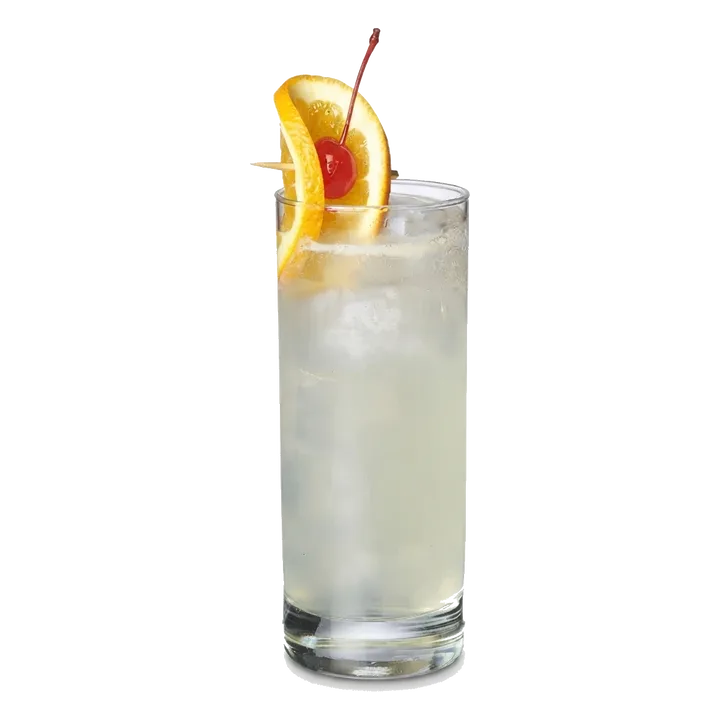
Tom Collins
4.2 201 ratings
Ingredients
How to make
Serve in a collins glass
Prepare
- 1 Select and pre-chill a COLLINS GLASS.
- 2 Prepare garnish of orange slice wheel and skewered Luxardo Maraschino Cherry (sail).
Method
- 3 SHAKE first 3 ingredients with ice.
- 4 STRAIN into ice-filled glass.
- 5 TOP with soda and briefly stir.
Garnish
- 6 Garnish with skewered orange slice wheel and maraschino cherry (sail).
Flavour profile
12.2% alc./vol. · 1.4 standard drinks · 177 calories
History
A medium-dry Gin Collins using old tom gin. Conventionally, Tom Collins uses old tom gin, while John Collins uses London dry gin (originally genever).
In his 1948 book, The Fine Art of Mixing Drinks, David A. Embury stated, "The original Collinses were always made with gin but, strangely enough, never with London dry gin - the very liquor that is practically always used in making a Collins today. The Tom Collins was made with Old Tom gin and the John Collins with Holland gin [jenever]." He further elaborated on the distinction between a Tom and John Collins: "The adoption of London dry gin as a Collins base gave rise to two schools of nomenclature. With one school, it was simply substituted for Old Tom gin in the Tom Collins. The other school, however, preferred to retain the Tom Collins name for the original drink made with Old Tom gin and, since Holland gin was practically never used any more in a Collins, they transferred the John Collins name to the Collins made with London dry gin. This accounts for the confusion that exists in present-day books of recipes. In some, the Tom recipe calls for Old Tom gin and the John recipe for dry gin; in others, the Tom recipe calls for dry gin and the John recipe for Holland gin. Actually, of course, Old Tom gin is merely a sweetened London gin. Consequently, we can make our Tom Collins with either Old Tom or London dry gin, but, if Old Tom gin is used, the quantity of sugar may need to be reduced by about half." The creation of the Collins is attributed to John Collins, who was employed at Limmer's Hotel on Conduit Street, London. The 'coffee house' at Limmer's Hotel was considered a true dive bar, frequented by sporting individuals during the 19th century and, according to the 1860s memoirs of Captain Gronow, a Victorian writer of four observational tomes, renowned for its Gin Punch as early as 1814. It is suggested that the Collins evolved from the Gin Punch, a popular beverage of that era. Whether John Collins, or possibly Jim, the head waiter at Limmer's, was the first to create or name the Tom Collins remains unknown, but he is commemorated in a limerick penned by Frank and Charles Sheridan concerning John Collins: "My name is John Collins, headwaiter at Limmer's, Corner of Conduit Street, Hanover Square, My chief occupation is filling brimmers For all the young gentlemen frequenters there. Mr. Frank always drinks my gin punch when he smokes." It is possible that the distinctive gin punch for which John Collins of Limmer's was known became known as the Tom Collins when it was prepared using Old Tom gin. An alternative narrative attributes the drink's origin to a Mr Collins, who commenced his employment at a New York tavern named the Whitehouse in 1873 and was known for crafting thirst-quenching gin concoctions. Another account identifies a different Tom Collins, who worked as a bartender in New Jersey and New York City. There are also versions suggesting its creation in San Francisco and Australia, and it is not inconceivable that the drink developed in multiple locations independently. Some propose that the Tom Collins originated in New York and derives its name from the Great Tom Collins Hoax, which captivated the city in 1874. This practical joke involved informing a friend that a person named Tom Collins had spoken disparagingly of them and could be found at a bar some distance away. It has been stated and documented on platforms such as Wikipedia that "A recipe for it [John Collins] appears in the Steward and Barkeeper's Manual of 1869," thereby suggesting the 'Hoax' was precisely that. However, upon reviewing the aforementioned 1689 manual, no mention of a Collins could be found. It is possible this claim is also a fabrication? Despite a scarcity of concrete evidence, it appears the Collins was an adaptation of the long-established Gin Punch, and John Collins may well have originated it at Limmer's. The original Collins likely utilized genever, followed by Old Tom gin, and finally London dry gin as gin availability and fashion evolved in London and New York. Each type of juniper spirit yields a differently characterized Collins – all of which are enjoyable, though an oude genever is preferred. In his 1882 publication, Bartenders' Manual, Harry Johnson provides recipes for a John Collins based on Holland Gin (genever) and a Tom Collins featuring Old Tom gin. JOHN COLLINS. (Use an extra large bar glass) 1 table-spoonful of sugar; 5 to 6 dashes of lemon juice; 1 wine glass full of Holland gin; 4 or 5 small lumps of ice; Open a bottle of plain soda water, pour this into the ingredients, mix up well, remove the ice, and serve. Careful attention must be paid when mixing the soda water with the above, not to let the foam of it spread over the glass. TOM COLLINS (Use an extra large bar glass) Three-quarters table-spoon of sugar; 3 or 4 dashes of lime or lemon juice; 3 or 4 pieces of broken ice; 1 wine glass of Old Tom gin; 1 bottle of plain soda water; mix up well with a spoon, remove the ice, and serve. Attention must be paid not to let the foam of the soda water spread over the glass. Thos. Stuart's 1904 book, Stuart's Fancy Drinks and How to Mix Them, contains a Tom Collins using Old Tom gin and a John Collins with "gin" – presumed to be London dry gin. Tom Collins. (Use an extra large bar glass) ¾ table-spoonful of sugar. 3 or 4 dashes of lime juice. 3 or 4 pieces of broken ice. 1 wine-glass of Old Tom gin. 1 bottle of plain soda. Mix well with a spoon, strain and serve. Attention must be paid not to let the foam of the soda spread over the glass; this drink must be drank as soon as mixed. John Collins' Gin. (Extra large bar glass) 1 table-spoon sugar. About 5 dashes lemon juice. 1 wine-glass gin. 5 or 6 small bits of ice. 1 bottle plain soda. Mix well, remove the ice, and serve.
Created by John Collins