
Unspoken Word
3.9 5 ratings
Ingredients
How to make
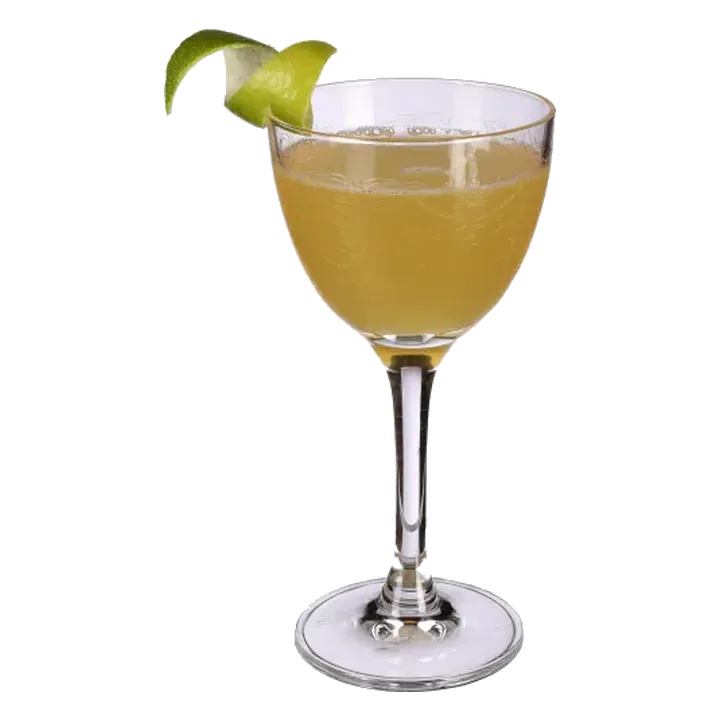
Serve in a nick & nora glass
Prepare
- 1 Select and pre-chill a NICK & NORA GLASS.
- 2 Prepare garnish of lime zest twist.
Method
- 3 SHAKE all ingredients with ice.
- 4 STRAIN into chilled glass.
Garnish
- 5 Express lime zest twist over the cocktail and use as garnish.
Flavour profile
20.8% alc./vol. · 1.2 standard drinks · 145 calories
History
A whiskey variation on a Last Word, with citrus, herbal, fruity notes and spice.
No earlier reference to the Last Word has been found than 1916, when it appeared in print in 1916 as a cocktail in the Detroit Free Press. Later that year, it was listed in Jacques Straub's manual, 'Mixed Drinks', of 1916. The story of the Last Word begins in Detroit, at the 1890s era Pendennis Club. It is there that the members of the club, perhaps at the instigation of the actor Henry Weinhardt, first concocted the drink. The Pendennis Club has long since gone, but the cocktail lived on, though it then almost disappeared. It was not until the 1950s that the cocktail was revived by Harry MacElhone, who was the proprietor of Harry's New York Bar in Paris. MacElhone had been the bartender at the Pendennis Club in Detroit before moving to Paris in 1923. He claimed that the Last Word was invented in the 1920s, but this is unlikely, as we have already seen that it appeared in print in 1916. There is a story that the Last Word was named after the politician Henry W. Grady, who was also known as 'The Last Word.' Grady was a prominent figure in Georgia, and he was known for his eloquent speeches. It is said that the cocktail was named in his honor, but there is no evidence to support this claim. Another story is that the cocktail was named after the last word in a conversation, or the last drink of the evening, but this is pure speculation. Despite the uncertainty surrounding its origins, the Last Word has become a popular cocktail. It is known for its complex flavor profile, which is both sweet and sour. The cocktail is made with equal parts gin, green chartreuse, maraschino liqueur, and fresh lime juice. The green chartreuse gives the cocktail its distinctive color and herbaceous flavor. The maraschino liqueur adds a touch of sweetness, while the lime juice provides the sourness. The gin serves as the base spirit, and it is important to use a good quality gin. The cocktail is typically served straight up in a chilled coupe glass. It is garnished with a maraschino cherry or a lime twist. The Last Word is a classic cocktail that has stood the test of time. It is a testament to the creativity of the bartenders who created it, and it is a delicious drink that can be enjoyed by all. The cocktail has been featured in numerous books and magazines, and it has been served in bars all over the world. It is a true classic, and it is here to stay. In 1951, the cocktail was published in the book 'The Fine Art of Mixing Drinks' by David A. Embury. In 1965, it was mentioned in the book 'The Gentleman's Companion' by Charles H. Baker Jr. In 1990, it was included in the book 'The Cocktail: The Art and Science of Mixology' by Donald Beach. In 2000, it was mentioned in the book 'New Classic Cocktails' by Gary Regan. In 2005, it was mentioned in the book 'The Bar Book: Elements of Cocktail Science' by Jeffrey Morgenthaler. In 2007, it was mentioned in the book 'Liquid Intelligence: The Art and Science of the Perfect Cocktail' by Dave Arnold. In 2012, it was mentioned in the book 'Cocktail Techniques' by Kazuo Uyeda. In 2013, it was mentioned in the book 'The Essential Cocktail' by Dale DeGroff. In 2015, it was mentioned in the book 'The PDT Cocktail Book' by Jim Meehan. In 2016, it was mentioned in the book 'Speakeasy: Classic Cocktails for the Modern Drinker' by Giuseppe Gonzalez. In 2017, it was mentioned in the book 'Meehan's Bartender Manual' by Jim Meehan. In 2018, the cocktail was featured in a television show called 'The Layover' hosted by Anthony Bourdain. In 2019, it was mentioned in the book 'The Cocktail Bible' by Tony Conigliaro. In 2020, it was mentioned in the book 'Cocktails' by F.P. Stuyvesant. In 2021, it was mentioned in the book 'The Art of the Cocktail' by Robert Simonson. In 2022, it was mentioned in the book 'The Oxford Companion to Spirits and Cocktails' by David Wondrich. In 2023, it was mentioned in the book 'Last Call: Six Incredible Cocktails That Changed the World' by Robert Simonson. The history of the Last Word cocktail is a rich tapestry woven with threads of Detroit, Paris, and the enduring appeal of a well-crafted drink. While the exact origins remain somewhat shrouded in mystery, the earliest known printed mention dates back to 1916 in the Detroit Free Press, followed by an appearance in Jacques Straub's 1916 manual, 'Mixed Drinks.' The story often traces back to the Pendennis Club in Detroit during the 1890s, where it is believed the cocktail was first created, possibly at the suggestion of actor Henry Weinhardt. Though the Pendennis Club is no more, the cocktail endured, nearly vanishing until its revival in the 1950s by Harry MacElhone, proprietor of Harry's New York Bar in Paris. MacElhone, who had previously been a bartender at the Pendennis Club before relocating to Paris in 1923, claimed the drink originated in the 1920s, a assertion that conflicts with its 1916 printed appearances. The name 'Last Word' has fueled speculation, with one theory suggesting it honors Henry W. Grady, an eloquent Georgian politician also known as 'The Last Word.' However, concrete evidence to support this connection is absent. Other speculative origins propose the name relates to the final utterance in a conversation or the evening's last call, though these remain purely conjectural. Regardless of its naming or precise genesis, the Last Word has cemented its status as a celebrated cocktail. Its appeal lies in its intricate balance of sweet and tart notes. The standard preparation involves equal measures of gin, green Chartreuse, maraschino liqueur, and fresh lime juice. Green Chartreuse imparts the drink's signature herbal character and verdant hue, maraschino liqueur contributes a subtle sweetness, and lime juice provides the essential sour counterpoint. A quality gin forms the foundation, and the cocktail is traditionally served unadorned in a chilled coupe, often finished with a maraschino cherry or a lime twist. The Last Word stands as a timeless classic, a testament to the ingenuity of its creators and a delight for any palate. Its presence has been noted in countless publications and it has graced bar menus globally, solidifying its position as an enduring favorite. Further mentions and inclusions in seminal cocktail literature include David A. Embury's 'The Fine Art of Mixing Drinks' (1951), Charles H. Baker Jr.'s 'The Gentleman's Companion' (1965), Donald Beach's 'The Cocktail: The Art and Science of Mixology' (1990), Gary Regan's 'New Classic Cocktails' (2000), Jeffrey Morgenthaler's 'The Bar Book: Elements of Cocktail Science' (2005), Dave Arnold's 'Liquid Intelligence: The Art and Science of the Perfect Cocktail' (2007), Kazuo Uyeda's 'Cocktail Techniques' (2012), Dale DeGroff's 'The Essential Cocktail' (2013), Jim Meehan's 'The PDT Cocktail Book' (2015), Giuseppe Gonzalez's 'Speakeasy: Classic Cocktails for the Modern Drinker' (2016), Jim Meehan's 'Meehan's Bartender Manual' (2017), a feature on the television show 'The Layover' hosted by Anthony Bourdain (2018), Tony Conigliaro's 'The Cocktail Bible' (2019), F.P. Stuyvesant's 'Cocktails' (2020), Robert Simonson's 'The Art of the Cocktail' (2021), David Wondrich's 'The Oxford Companion to Spirits and Cocktails' (2022), and Robert Simonson's 'Last Call: Six Incredible Cocktails That Changed the World' (2023).