
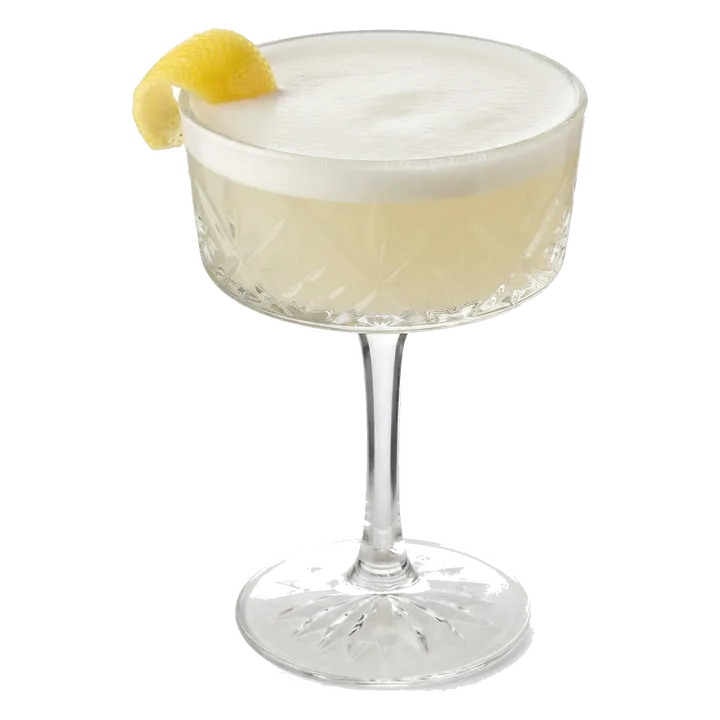
White Lady
4.2 407 ratings
Ingredients
How to make
Serve in a coupe glass
Prepare
- 1 Select and pre-chill a COUPE GLASS.
- 2 Prepare garnish of lemon zest twist.
Method
- 3 SHAKE all ingredients with ice and strain back into shaker.
- 4 DRY SHAKE (without ice).
- 5 FINE STRAIN into chilled glass.
Garnish
- 6 EXPRESS lemon zest twist over the cocktail and use as garnish.
Flavour profile
18.5% alc./vol. · 1.7 standard drinks · 197 calories
History
A smooth, delightful gin cocktail with a tart conclusion. The proportions used in this White Lady recipe mirror those in Harry Craddock's 1930 formulation, featuring 2 parts dry gin, 1 part triple sec, and 1 part lemon juice. However, the sugar content in contemporary triple secs, such as Cointreau, does not sufficiently counteract the acidity of the lemon juice, as many triple sec liqueurs have become less sweet since 2000. Consequently, depending on the tartness of the lemons used, a dash or even a splash of sugar syrup may be necessary to achieve balance. This addition of egg white, pioneered by The Savoy's American Bar where Peter Dorelli consistently prepared his signature White Lady with it, has become standard practice in most parts of the world. Nevertheless, this practice has not gained traction in Japan, where bartenders like Hidetsugo Ueno San strongly object to the inclusion of egg white in any cocktail, contrasting with the Japanese acceptance of raw fish. It is suggested that the Japanese preference against using egg white stems more from cultural considerations than from taste preferences, and that egg white enhances the White Lady. It also contributes to the drink's color. The appealing, frothy white foam created by aerating the egg conceals a pale yellow liquid that is hardly fitting for the drink's name. Arguments against using egg white suggest the name derives not from its color but from the many spectral female figures in mythology. While this may be true, a frothy white head offers a more pleasing visual than a pale yellow hue, and the drink is improved by its presence!
Like so many cocktails, the history of the White Lady is debatable. However, the recipe we recognise today originated in the late 1920s, probably created by Victor Cabrin at London's Grosvenor House Hotel, and was popularised by Harry Craddock, who included it in his 1930 The Savoy Cocktail Book. Harry MacElhone, from Dundee, Scotland, created the first White Lady cocktail while working at London's Ciro's Club in 1919. However, this consisted of equal parts brandy, crème de menthe, and Cointreau, shaken and strained into a cocktail glass, so very different from the White Lady we know today with gin, triple sec, and lemon juice. Harry's brandy-based crème de menthe recipe appears in his 1922 Harry's ABC of Mixing Cocktails and is repeated the following year as in Harry of Ciro's ABC of Mixing Cocktails. White Lady Cocktail. 1/6 Brandy, 1/6 Crème de Menthe, 2/3 Cointreau. Shake well and strain. MacElhone is also said to have created the version of the White Lady we know today in 1929 while at his own Harry's New York Bar in Paris, France. This is reaffirmed in modern-day versions of his book by his family, but there is no evidence to support this and MacElhone's claim to the creation of the gin-based White Lady is disputed by most, including London's The Savoy Hotel who say this now dominant version was first created at the hotel's The American Bar by Harry Craddock. The story goes that F. Scott Fitzgerald's wife, Zelda, was drinking at The Savoy, and Craddock named the drink after her because she was a platinum blonde. When The Savoy's American Bar was refurbished in 1927, Craddock is said to have placed a cocktail shaker with the ingredients for a White Lady in the brickwork being laid as part of the building work. This is two years before MacElhone is said to have reworked his recipe at his new bar in Paris and when Victor Cabrin is credited with creating the White Lady. Craddock's buried shaker is yet to be unearthed, and this 1927 burial is perhaps being confused with Craddock burying another shaker in 1939, this time at The Dorchester Hotel when he moved there. This later burial's inclusion of a corked vial of White Lady, along with four other cocktails and accompanying recipes, is widely reported in newspapers of the time, many of which also say Craddock created the White Lady in 1920, probably just relaying what the press release said rather than being based on fact. A recipe for the White Lady appears in Craddock's 1930 The Savoy Cocktail Book, but he makes no claim to his creation. WHITE LADY COCKTAIL. ¼ Lemon Juice. ¼ Cointreau. ½ Dry Gin. Shake well and strain into cocktail glass. MacElhone's revised White Lady recipe is "1/3 lemon juice, 1/3 Cointreau, 1/3 gin" - the same ingredients, but Craddock's recipe uses twice as much gin to make a properly gin-based sour cocktail. Whether Craddock adapted MacElhone's recipe or MacElhone adapted his to resemble Craddock's, so he could continue to claim the popular version as being his own is further muddied by a third and fourth contender for the creator of the White Lady Cocktail. The 2021 Oxford Companion to Spirits and Cocktails cites a vintage Along the Wine Trail column in the New York Sun where regarded drinks writer G. Selmer Fougner, identifies the White Lady's origin as being the bar at London's Quaglino's restaurant. However, there is a greater weight of evidence behind the true originator of the (gin-based) White Lady being Victor Cabrin, the regarded bartender at the bar named after him at London's Grosvenor House. An advertisement for Booth's Dry Gin in The Illustrated London News on the 5th May 1934 features Victor mid-shake while making his White Lady. Victor's claim is further supported in a piece by Miss Ann Todd in The Daily Mirror on 30th October 1935, titled "Go and Drink Coal!" proclaiming Victor as not just the creator of the White Lady but also the Blue Lady and Black Lady cocktails. Go and Drink Coal! Fashionable cocktail drinkers will in future be seen swallowing what looks like liquid coal - but isn't. It's the "Black Lady" cocktail, latest invention of Victor, the famous Grosvenor House bartender, who originated both the "White Lady" and the "Blue Lady." He calls it a "pure black mammy" without a suspicion of mulatto[sic]. Here is what its made of:- Cocoa syrup. Cocoa kola with amer picon. White of egg and akvavit. This colour idea in cocktails is interesting as long as fashion doesn't decide that those who drink them must dress to match, or have nails coloured to contrast!" Then a piece titled "Originator of the White Lady Cocktail" in the Eastbourne Chronicle on the 23rd November 1946 reports on Victor's move from the Grosvenor House to the local Queen's Hotel. ORIGINATOR OF THE "WHITE LADY" COCKTAIL CELEBRATED BARMAN AT THE QUEEN'S HOTEL The originator of the famous cocktail, "White Lady," Mr. Victor Cabrin, is now supervising the new lounge bar of the Queen's Hotel, having come to Eastbourne after many years service in "Victor's Bar" at the Grosvenor House Hotel. "Victor" invented the cocktail in 1929, and the flavour quickly caught on and has proved a popular drink in bars all over the world. One of the most amusing incidents "Victor" recalls was when a young couple asked him to mix up a special drink which they called "Two Tigers in a taxi." "I was horrified when they told me what to mix up," he told a "Chronicle" reporter, "and when they had drunk it my fears were fully justified for they both turned green"! "Victor" cannot mix his famous cocktails at the moment for with the shortage of eggs and cointreau he is unable to do justice to the "White Lady." Truth is, the real bartender behind the White Lady's creation is lost in time, but while Craddock remains most identified with the White Lady, I believe it was Victor Cabrin that created it. Egg white Early recipes, including MacElhone's own Harry's ABC of Mixing Cocktails and Harry Craddock's 1930 The Savoy Cocktail Book make no mention of the use of egg white. This first appears a White Lady recipe published in The Sacramento Bee newspaper on 17th December 1936. The first White Lady recipe with egg white in a specialist cocktail book appears in Lucius Beebe's 1946 The Stork Club Bar Book as one of a "miscellaneous clutch of cocktails which Mr. Billingsley's day-shift Ganymedes report as being in current high favour with the carriage trade." White Lady 1½ oz gin. ¾ oz Cointreau juice of half lemon egg white Shake and serve in 4oz wine glass. Tellingly, the piece from the 1946 Eastbourne Chronicle [above] tells us that Victor Cabrin used egg white and Cointreau in his recipe.
Created by Victor Cabrin